How to Open a Company in Italy 2026: Step-by-Step Complete Guide for Foreigners
Quick answer: Foreigners open an Italian company by choosing its structure, preparing documents, executing the notarial deed and registering with the Business Register.
- An SRL can start from €1, with special payment and reserve rules below €10,000.
- Indicative SRL formation costs are €2,500-5,000.
- Incorporation does not itself grant a visa, residence permit or right to work in Italy.
Opening a company in Italy as a foreign entrepreneur represents a strategic move into one of Europe's largest economies. Italy's business landscape offers unique opportunities, from access to the EU single market to specialized manufacturing sectors and growing innovation hubs. This comprehensive 2026 guide walks you through every aspect of company formation, from choosing the right legal structure to navigating bureaucracy and ensuring long-term compliance.
Italy's Business Environment: 2026 Overview
Italy's economy continues to transform, with significant growth in digital services, sustainable manufacturing, and export-oriented businesses. The Italian government has streamlined many company formation processes, making it increasingly attractive for foreign entrepreneurs to establish operations.
Official data on doing business in Italy:
- Company registrations, foreign-owned firms and FDI flows are tracked by ISTAT, the Bank of Italy and Unioncamere: cite the latest annual release rather than a fixed percentage
- Foreign-owned companies in Italy number in the hundreds of thousands and cluster in trade, construction and services
- Incorporation is now largely digital (notarial deed, Registro Imprese and tax filings are transmitted electronically), but bank onboarding usually remains the slowest step
Understanding Italian Company Types: Decision Framework
SRL (Società a Responsabilità Limitata) - The Popular Choice
The SRL (Limited Liability Company) represents Italy's most popular corporate form for foreign entrepreneurs. It combines asset protection with operational flexibility, making it ideal for businesses ranging from consulting firms to small manufacturing operations.
If you are still deciding whether to incorporate, compare an SRL with a sole proprietorship.
Key Features:
- Share capital: the standard amount is €10,000, but an SRL may be incorporated from €1 under art. 2463.
- Below €10,000: capital is paid in full in cash; at least 20% of annual net profit goes to a special reserve until capital plus reserve reaches €10,000.
- At €10,000 or more: at least 25% of cash contributions is generally paid at incorporation; a sole shareholder pays them in full.
- Liability: Shareholders are generally liable only up to their subscribed contribution, subject to statutory exceptions and guarantees they personally give.
- Shareholders: no statutory cap; a sole-shareholder SRL is permitted (individuals or companies)
- Management: Flexible director structure
- Best For: Most foreign businesses, professional services, e-commerce, consulting
Indicative cost structure:
- Formation: €2,500-5,000
- Annual compliance: €3,000-6,000
- Recommended capital: €10,000-50,000
SRLS (Società a Responsabilità Limitata Semplificata) - Budget Option
The SRLS (Simplified SRL) offers reduced formation costs for smaller businesses with straightforward operations.
Key Features:
- Minimum capital: €1-9,999.99, paid in full in cash at incorporation
- Formation cost: lower than a tailor-made SRL — the standard ministerial model keeps notarial and public fees down (ask the notary for a quote)
- Limitations: the standard model's clauses cannot be customised and shareholders must be individuals (art. 2463-bis)
- Best For: Simple ownership and governance needs that fit the non-modifiable standard articles; revenue is not an SRLS eligibility criterion.
SPA (Società per Azioni) - Corporate Structure
The SPA (Joint Stock Company) suits larger businesses planning significant growth or potential public listing.
Key Features:
- Minimum Capital: €50,000
- Shareholders: Unlimited
- Management and controls: The articles select one of the statutory governance models. The audit or statutory-auditor structure depends on that model and the applicable legal requirements.
- Best For: Larger capital structures, businesses raising investment and potential public-market plans.
Partnership Options
- SNC (General Partnership): All partners have unlimited and joint liability for partnership debts.
- SAS (Limited Partnership): General partners manage and have unlimited liability; limited partners have liability limited to their contribution if they respect their non-management role.
- SS (Simple Partnership): Used for non-commercial activities, including some professional or property-holding arrangements; it is not a limited-liability partnership.
Company Type Comparison Matrix
| Feature | SRL Standard | SRLS Simplified | SPA Joint Stock | SNC Partnership |
|---|
| Minimum capital | €10,000 standard, or from €1 with the low-capital payment and reserve rules | €1-9,999.99 (fully paid at incorporation) | €50,000 | No statutory minimum |
| Formation cost | €2,500-5,000 (indicative) | lower (standard model) | €5,000-15,000 (indicative) | €500-2,000 (indicative) |
| Liability Protection | Limited | Limited | Limited | Unlimited |
| Shareholder limit | No statutory cap | Individuals only | Unlimited | No limit |
| Annual Compliance | €3,000-6,000 | €1,500-3,000 | €5,000-12,000 | €1,000-3,000 |
| Best For | Most businesses | Small enterprises | Large companies | Professional services |
The cost rows are planning ranges, not regulated tariffs. Obtain written quotes from the notary, accountant, registration provider and bank for the actual ownership structure and activity.
Foreign ownership, reciprocity and the right to work
EU and EEA founders may incorporate under the same company-law conditions as Italians. For some non-EU/EEA nationals or foreign corporate shareholders, the notary must verify the condition of reciprocity for the particular act unless an exempt residence status, treaty or bilateral investment agreement applies. It is a country- and act-specific analysis, not a universal requirement for an Italian partner.
Owning shares or incorporating remotely does not itself grant a visa, residence permit or right to work in Italy. A non-EU founder who moves to Italy to run the business must obtain the appropriate immigration permission. Conversely, a non-resident shareholder does not need a self-employment visa merely to hold shares. A resident director is not universally required by company law, although management location, tax, banking, service-of-process and immigration consequences must be planned.
If you plan to remain abroad, read the guide to opening an Italian SRL remotely without moving alongside the immigration distinction above.
Business Activity Classification (ATECO Code)
Italy uses ATECO codes to classify business activities. Your code determines:
- Tax obligations and rates
- Required licenses and permits
- Social security requirements
- Industry-specific regulations
Example ATECO Classifications:
- 62.01.00: Computer programming activities
- 47.19.10: Retail sale via internet
- 70.22.09: Business consulting activities
- 85.59.10: Educational support services
Capital Structure Planning
Recommended Capital Guidelines by Business Type:
| Business Type | Recommended Capital | Reason |
|---|
| Consulting/Services | €10,000-25,000 | Operational buffer, client credibility |
| E-commerce | €15,000-50,000 | Inventory, marketing, systems |
| Manufacturing | €50,000-200,000+ | Equipment, facilities, supply chain |
| Import/Export | €25,000-100,000 | Working capital, logistics |
| Technology Startup | €25,000-100,000 | Development, scaling, talent |
Phase 1: Preparation
Core document checklist — confirm it with the notary:
- Valid passports or IDs for shareholders and directors
- Italian tax codes (codici fiscali) for the participants who need them
- Ownership, director and beneficial-owner information
- Draft company name, purpose, governance and articles
- Registered-office details
- Evidence and payment mechanics for the chosen contributions
- Powers of attorney for any participant not attending
- Translations, apostilles or consular legalisation only for the foreign documents and countries for which they are required
Professional Appointments:
- Commercialista (Accountant): Tax advice and registration
- Notary: Company incorporation and legal formalities
- Legal Counsel: Contract review and compliance
Phase 2: Incorporation and registration
Core steps:
- Check the company name: The notary checks that the proposed name is distinguishable and lawful; this is not a universal stand-alone reservation procedure.
- Finalise the deed and articles: Set capital, ownership, corporate purpose and governance.
- Complete contribution formalities: Follow the cash or in-kind contribution process agreed with the notary; an in-kind contribution may require a valuation report.
- Execute the notarial deed: Attend or use a valid power of attorney.
- Register the company: The notary files the deed with the Business Register. The company acquires legal personality upon registration.
Critical Legal Documents:
- Statuto (Articles of Association): Company governance rules
- Atto Costitutivo (Incorporation Deed): Legal incorporation document
- Verbale di Assemblea (Shareholder Meeting Minutes): Founding resolutions
Phase 3: Tax, employment and operational setup
Registrations depend on the activity and staffing:
- Tax and VAT: Confirm the Partita IVA, tax options and invoicing setup.
- Business Register/REA filings: File activity commencement and any required SCIA or sector authorisation.
- INPS and INAIL: Register where required by directors', working shareholders' or employees' positions and the insured activity.
- PEC and digital signature: Maintain the company's digital domicile and the credentials needed for filings.
Banking Setup Process:
- Open Corporate Bank Account: Requires shareholder presence or POA
- Activate Online Banking: Digital payment systems
- Setup Payment Processing: Credit card acceptance if retail
- Establish Credit Lines: Working capital financing
| Cost Category | SRL Standard | SRLS | SPA | Notes |
|---|
| Notary Fees | €1,500-2,500 | €500-800 | €2,500-5,000 | Based on capital and complexity |
| Registration Taxes | €200-400 | €200 | €400-600 | Fixed government fees |
| Chamber Fees | €100-300 | €100 | €200-400 | Business registration |
| Legal Advisory | €1,000-2,000 | €300-500 | €2,000-5,000 | Document preparation |
| Accounting Setup | €500-1,000 | €200-400 | €1,000-2,000 | Initial tax registrations |
| Bank Opening | €200-500 | €100-300 | €300-800 | Account setup fees |
| Office Setup | €1,000-3,000 | €500-1,000 | €2,000-5,000 | Registered office, equipment |
First-Year Operating Budget
Minimum Annual Operating Costs:
- Registered Office: €2,400-4,800 (€200-400/month)
- Accounting Services: €3,000-6,000
- Bank Fees: €500-1,200
- Digital Services: €500-1,000 (PEC, software, signatures)
- Insurance: €800-2,000
- Compliance: €1,000-2,000 (annual filings, audits)
Total First-Year Budget: €8,200-21,000
Banking Solutions for Foreign Companies
Traditional Banking Options
Major Italian Banks with Foreigner Programs:
- UniCredit: International business banking, English support
- Intesa Sanpaolo: Global business services, specialized foreign desks
- Banca Sella: Digital-first banking for SMEs
- Mediobanca: Investment banking for larger operations
FinTech and Digital Banking
Modern Banking Solutions:
- N26 Business: German bank operating in Italy, online-only
- Revolut Business: Multi-currency accounts, competitive FX rates
- Hype Business: Italian digital bank with business accounts
- Extrabanca: Specialized banking for foreigners and immigrants
Bank Account Opening Requirements:
- Company incorporation documents
- Shareholder identification documents
- Business plan and financial projections
- Proof of business activity
- Tax registration certificates
Tax System Overview for Foreign Companies
Corporate Tax Structure
Main Corporate Taxes:
- IRES (corporate income tax): 24% of taxable profits (art. 77, TUIR)
- IRAP (regional tax on productive activity): the ordinary rate is 3.9% (art. 16, D.Lgs. 446/1997) and it is applied to the net value of production, not to accounting profit — regions may vary the rate
- IVA (VAT): 22% standard rate, reduced rates available
- Municipal Taxes: Varies by location and property
Recurring filing calendar:
- Corporate income-tax and IRAP returns: The filing deadline depends on the tax period and current return instructions; it is not a universal 30 April deadline.
- VAT: Periodic settlements may be monthly or quarterly where eligible; LIPE communications and the annual VAT return are separate obligations with their own deadlines.
- Financial statements: Shareholders normally approve within 120 days of year-end, or up to 180 days only where statutory conditions and the articles allow; filing is due within 30 days after approval.
- Payroll and social security: Monthly payments and declarations usually apply when the company has employees; the exact calendar depends on the workforce.
Tax incentives require a current-law check
Potential measures can include R&D and innovation credits, the patent-box extra deduction for qualifying IP-related costs, investment incentives and hiring reliefs. Eligibility, qualifying expenditure, ceilings, recapture rules and application windows change frequently.
Verify the measure in force when the investment is made and obtain the required technical and accounting evidence before including an incentive in the business plan. A prior year's headline percentage is not a reliable 2026 entitlement.
Hiring Employees in Italy
Employment Law Framework
Key Employment Regulations:
- Working time: The normal statutory week is 40 hours, while collective agreements may set a shorter normal week; average maximum-working-time and rest rules also apply.
- Annual leave: At least four weeks, subject to the timing rules and any more favourable collective agreement.
- TFR: A statutory severance accrual calculated under art. 2120 of the Civil Code, broadly using annual remuneration divided by 13.5 and adjusted by the statutory contribution.
- Social security and insurance: Employer cost varies by sector, role, contract, benefits and INAIL risk; model it with a payroll adviser rather than applying one universal percentage.
Hiring Process Requirements:
- Employment Contract: Written agreement required
- INPS Registration: Employee social security enrollment
- INAIL Coverage: Workplace insurance activation
- Work Permits: For non-EU employees
- Contract Registration: Submit to relevant authorities
Cost of Employment Analysis
Illustrative employment-cost model:
Gross salary is only one component. Employer INPS contributions, INAIL premium, TFR, contractual welfare, leave and payroll charges depend on the employee's classification and the applicable collective agreement. Obtain a payroll simulation for the role and location; a single 37% uplift is not a dependable rule for every hire.
Ongoing Compliance Requirements
Annual Obligations Calendar
Monthly Requirements:
- Payroll processing and social security payments
- VAT accounting and quarterly preparation
- Bank reconciliation and financial reporting
Quarterly Requirements:
- VAT returns (if quarterly filing)
- Intrastat declarations (EU trade reporting)
- Social security summary filings
Annual Requirements:
- Financial statement preparation and approval
- Annual tax returns (IRES, IRAP, VAT)
- Shareholder meeting minutes
- Beneficial ownership register updates
- Chamber of Commerce annual fee (assessed on turnover, with a minimum amount set each year)
Compliance Risk Management
Common compliance pitfalls:
- Late or incorrect VAT, income-tax or payroll filings
- Incorrect employee or contractor classification
- Missing corporate approvals and Business Register filings
- Inadequate accounting or beneficial-owner documentation
- Applying incentives or cross-border tax treatments without the required evidence
Penalties depend on the specific return, tax, delay, remediation and effective date of the law. Avoid generic percentage ranges: assess the provision governing the actual breach and whether voluntary correction (ravvedimento operoso) remains available.
Technology Companies
Technology-Specific Requirements:
- ATECO Classification: Usually 62.01.00 (software) or 63.11.00 (data processing)
- Additional Registrations: Privacy (GDPR) compliance, software licensing
- Intellectual Property: Patent and trademark registration
- R&D Incentives: Tax credits for development activities
Additional intellectual-property or regulated-activity work can run alongside incorporation and may affect the operational launch.
Import/Export Businesses
Trade-Specific Requirements:
- EORI Registration: Customs identification number
- VAT Registration: Special schemes for intra-EU trade
- Import/Export Licenses: Industry-specific permits
- Customs Bonds: Financial guarantees for imports
Customs, EORI and sector-licensing steps can determine when trading can begin even after the company is registered.
Professional Services
Professional Practice Requirements:
- Professional Registration: Chamber of professional orders
- Professional Insurance: Mandatory liability coverage
- Continuing Education: Ongoing professional development
- Ethical Standards: Professional code compliance
Professional registration and authorisation requirements depend on the regulated activity and may precede commencement.
Regional Considerations: Best Locations for Business
Northern Italy (Milan, Turin, Venice Region):
- Advantages: Strong economy, international connections, skilled workforce
- Best For: Technology, finance, manufacturing, export businesses
- Operating Costs: Higher wages, commercial real estate premiums
Central Italy (Rome, Florence):
- Advantages: Government contracts, tourism industry, cultural connections
- Best For: Professional services, tourism, creative industries
- Operating Costs: Moderate-high, varies significantly by location
Southern Italy (Naples, Bari, Sicily):
- Advantages: Government incentives, lower operating costs, strategic location
- Best For: Manufacturing, logistics, import/export, tourism
- Operating Costs: Lower labor and real estate costs, available subsidies
Exit Strategy and Business Growth
Growth Planning Options
Business Scaling Strategies:
- SRL to SPA Conversion: For significant growth or public listing
- Foreign Branch Expansion: Establish operations in other countries
- Merger/Acquisition: Consolidate market position
- Franchise Development: Expand business model through licensing
Exit Planning Considerations
Common Exit Strategies:
- Share Sale: Sell entire business to strategic buyer
- Gradual Transfer: Phased ownership transition to family/employees
- Asset Sale: Sell business assets separately
- Company Liquidation: Wind down operations and distribute assets
Tax Implications:
- Capital gains on share sales: 26% in the standard case, with participation-exemption rules available to corporate sellers subject to conditions; for a non-resident seller the outcome depends on the size of the holding and the applicable tax treaty, so model the exit before signing
- Succession planning benefits for family transfers
Practical sequence: e-commerce example
An e-commerce founder can use this dependency checklist:
- Obtain the required tax codes and define shareholders, directors, capital, company purpose and registered office.
- Give the notary any foreign documents in the form required for their country of origin and sign the deed in person or under a valid power of attorney.
- Confirm Business Register registration, Partita IVA, PEC and digital-signature access.
- Complete bank KYC and payment-provider onboarding.
- File any activity commencement, consumer, privacy, packaging, product-safety or sector notices that apply before trading.
The notarial registration date is not the same as the operational launch date. Banking, licences and platform compliance can finish later, so no fixed eight-week or €12,500 outcome should be promised without a scoped quote and dependency review.
Frequently asked questions
Can I open a company in Italy remotely from abroad?
The deed can often be signed through a valid power of attorney, subject to the notary accepting the document and its authentication, apostille or legalisation. Bank KYC and regulated-activity requirements may still require direct interaction. An Italian resident director is not universally required by company law.
Do I need an Italian partner?
Not as a general rule. EU/EEA founders can own the company under the same conditions as Italians. For some non-EU/EEA founders or foreign corporate shareholders, the notary must verify reciprocity or an applicable exemption or treaty. Ownership does not itself grant a right to live or work in Italy.
How long does company registration take?
There is no responsible universal promise. Once the notary has a complete file, the deed and Business Register filing can proceed quickly; tax codes, powers of attorney, foreign-document formalities, bank KYC and sector licences often determine the actual launch date.
What are the minimum capital rules?
An ordinary SRL may be incorporated from €1. Below €10,000, capital is paid fully in cash and at least 20% of annual net profit is allocated to the special reserve until capital plus reserve reaches €10,000. At €10,000 or more, at least 25% of cash contributions is generally paid at incorporation, or 100% for a sole shareholder. An SRLS uses €1-9,999.99 and the statutory standard articles; an SPA requires €50,000.
Can I use my existing foreign company in Italy?
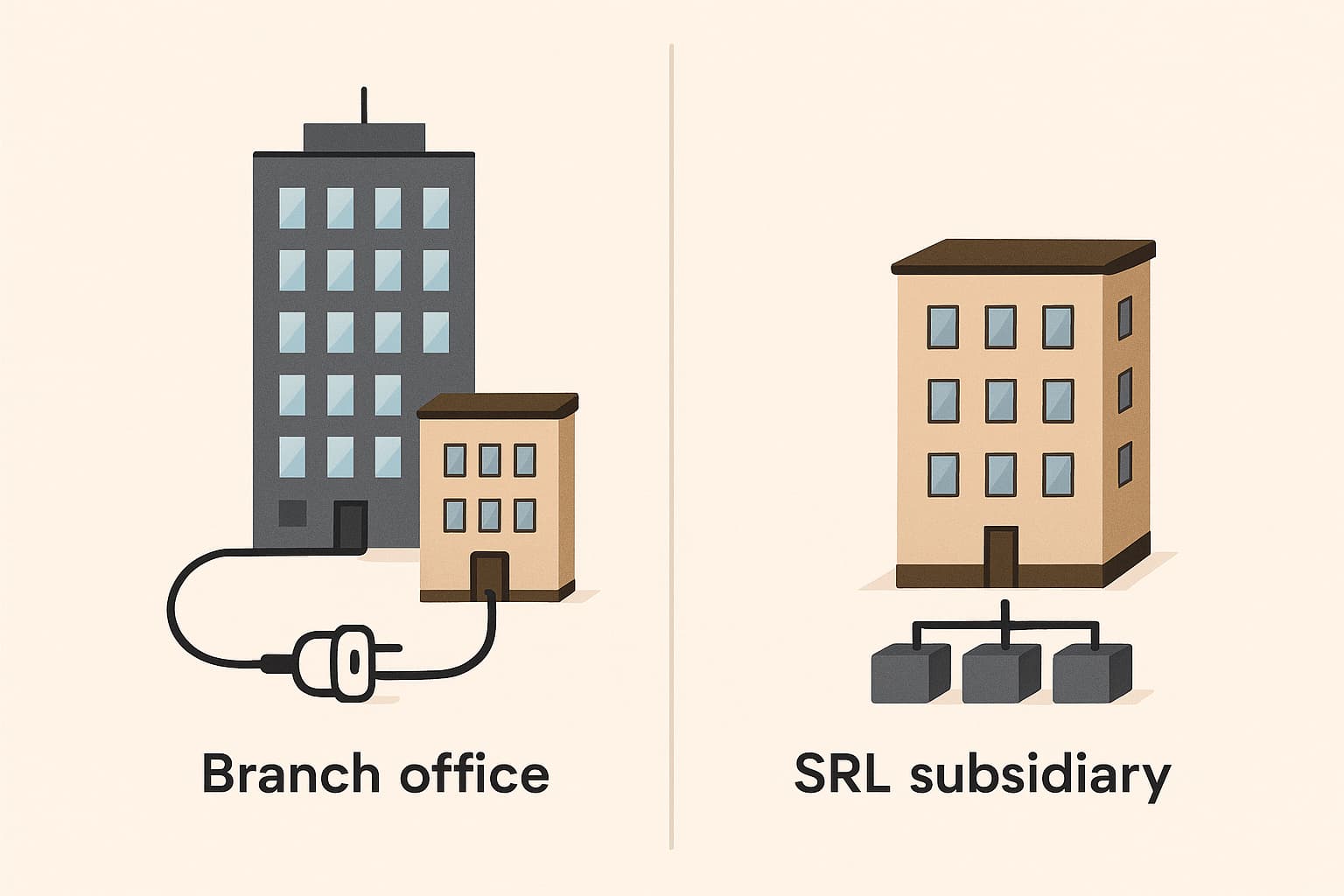
Depending on the facts, a foreign company may sell cross-border without an Italian establishment, register a branch, or incorporate an Italian subsidiary. VAT, permanent-establishment, licensing, payroll and Business Register consequences differ, so “branch or subsidiary” is not an automatic choice detached from the actual activity.
What ongoing compliance costs should I expect?
Accounting, payroll, registered office, banking, insurance and filing costs depend on transactions, employees, sector and group reporting. Request a scope-based annual quote; the ranges in this guide are planning illustrations rather than regulated prices.
How do I choose the right ATECO code?
Select the code that reflects the activity actually carried on and check the current ATECO classification, sector licences and INPS/INAIL consequences with the advisers handling commencement.
Can I change company type later?
Italian companies can transform from one legal form to another when the statutory procedure is met. The required resolutions, notarial deed, creditor protections, accounting and tax consequences depend on the transformation.
What banking challenges do foreign founders face?
Banks apply their own KYC and risk policies. They may require detailed ownership, source-of-funds and transaction evidence or direct identification. Incorporation does not guarantee an account, so start bank onboarding early and keep an alternative licensed provider under review.
Next Steps: Getting Started
- Business Plan Development: Finalize your business model and financial projections
- Company Structure Decision: Choose the appropriate legal form based on your needs
- Professional Team Assembly: Engage commercialista, notary, and legal counsel
- Document Preparation: Ask the notary which documents need translation, apostille or legalisation before ordering them
- Capital Planning: Secure funding and arrange capital transfer
Professional Support Options
Company Formation Services:
- Full-service incorporation handling all bureaucratic steps
- Remote processing with Power of Attorney
- Bank account opening assistance
- Ongoing compliance and accounting support
Specialized Consultancy:
- Tax planning and optimization strategies
- Immigration and visa assistance
- Market entry and business development
- Legal compliance and contract review
Opening a company in Italy as a foreign entrepreneur requires careful planning, professional guidance, and understanding of the local business environment. With the right preparation and support, Italy offers excellent opportunities for international businesses seeking to access European markets and benefit from the country's strategic location and skilled workforce.
Whether you're establishing a small consulting practice or launching a manufacturing operation, this guide provides the foundation for successful company formation in Italy's dynamic business landscape.
For the strategic picture — which structure, which regime and what it really costs — see our guide to starting a business in Italy as a foreigner. This article covers the operational sequence.
Ready to plan your Italian company? Our commercialista, legal and business advisers can coordinate the formation file, tax setup and operational requirements. Final notarial, banking, licensing and public-authority decisions remain with the competent parties.
Schedule Your Free Consultation | Explore Company Formation Services
Related Articles


 Giovanni Emmi|February 10, 2026