Branch Office vs SRL in Italy: Which Structure Should Foreign Companies Choose in 2026?
When your company is ready to enter the Italian market, the first structural decision is rarely about which city or which sector. It is about how to establish a legal presence. Two options dominate: opening a branch office (filiale) of your existing foreign company, or incorporating a separate Italian SRL (Società a Responsabilità Limitata) as a subsidiary.
Both paths give you a registered presence in Italy, allow you to invoice Italian clients, employ staff, and operate in the local market. But they differ fundamentally in liability, cost, governance, tax treatment, and long-term flexibility. Choosing the wrong one can mean exposing your parent company to unnecessary risk, paying more in compliance than your Italian operation generates, or restructuring later at significant expense.
This guide compares both structures across the factors that matter most: legal personality and liability, setup process and costs, taxation, compliance burden, banking, and practical scenarios. It draws on the Italian Civil Code (Articles 2508–2510 for branches), established notarial practice, and the author's experience advising foreign companies entering Italy.
Plan your Italy market entry with a specialist →
See our Company Formation Service →
Disclaimer: This guide is informational, not legal or tax advice. Specific circumstances vary. Work with an Italian commercialista and notary to determine the appropriate structure for your situation.
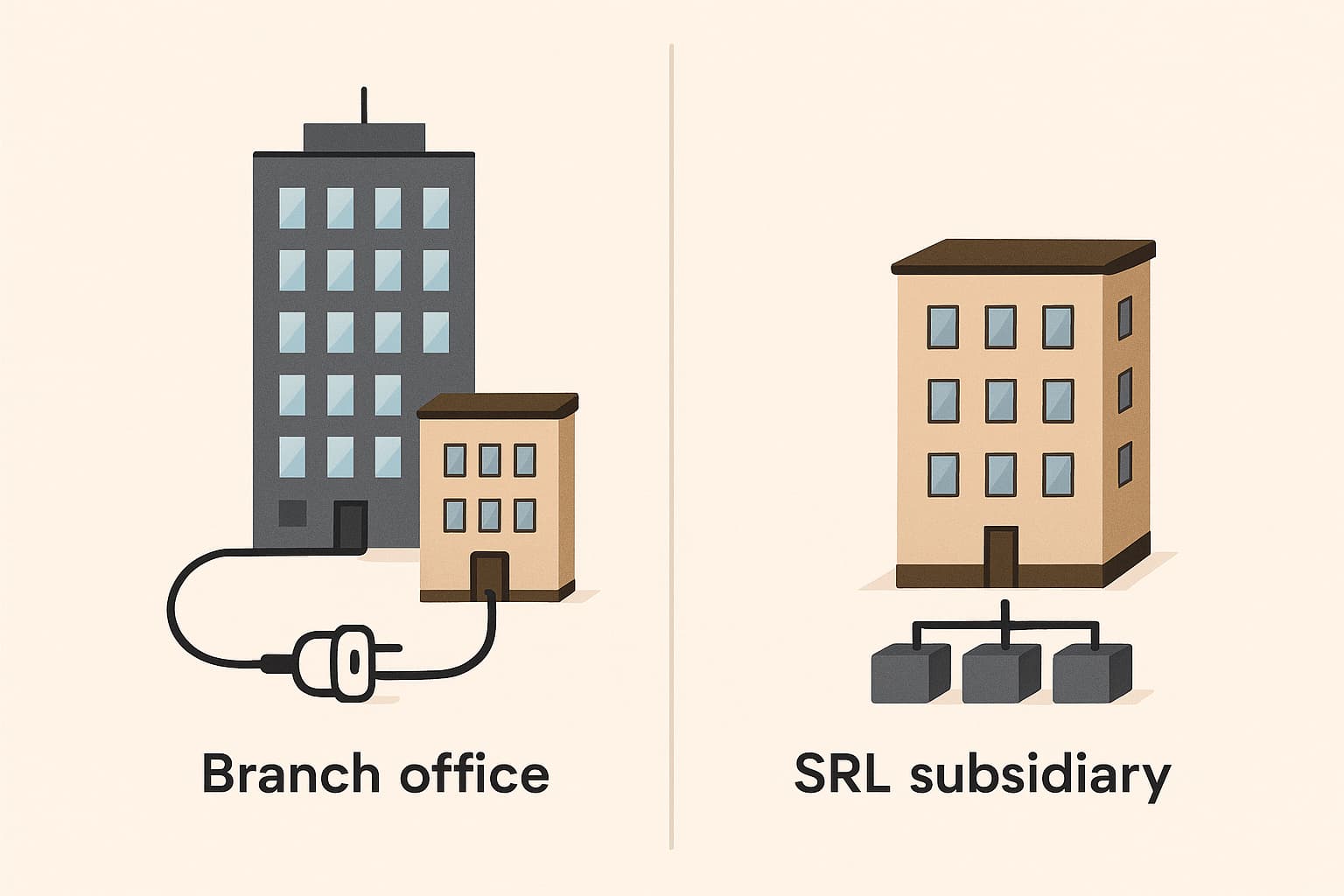
The Core Difference: Separate Legal Entity vs Extension of the Parent
The most important distinction between an SRL and a branch is legal personality.
An SRL is a separate legal entity incorporated under Italian law. It has its own assets, liabilities, tax obligations, and governance structure. The shareholders — whether individuals or companies — benefit from limited liability: they risk only the capital they have invested. Creditors of the SRL cannot generally pursue the shareholders' personal or corporate assets.
For a standard SRL, the minimum share capital is €10,000, of which at least 25% must be paid in before incorporation (the full amount if there is a single shareholder). Since the 2019 reform, it is also possible to incorporate an SRL with €1 of capital, but only by using the simplified SRL (SRL semplificata) procedure with standard bylaws and additional restrictions. In practice, most foreign companies choose a standard SRL with €10,000 capital to preserve contractual flexibility.
A branch (filiale) is not a separate legal entity. Under Article 2508 of the Italian Civil Code, it is an extension of the foreign parent company, operating under the parent's legal identity and name. The parent company remains fully and directly liable for all obligations the branch incurs — contracts, debt, tax liabilities, employment claims, and litigation. If the branch defaults on a payment to an Italian supplier or fails to remit VAT, the foreign parent is on the hook.
This difference drives almost every other choice downstream.
Liability: Where the Risk Lives
For foreign companies with significant assets outside Italy, liability is often the deciding factor.
With an SRL, liability is contained. The SRL is responsible for its own debts. If the Italian operation fails, creditors generally cannot reach the parent company's assets beyond its investment in the SRL's shares. This is particularly important when the Italian activity involves physical operations, employees, inventory, or contracts with customers who could bring claims.
With a branch, liability is unlimited. The parent company is directly exposed to every liability the branch creates. A dismissed employee's lawsuit, a supplier's unpaid invoice for goods delivered to the branch, or a tax assessment from the Italian Revenue Agency — all become claims against the parent. For this reason, a branch is rarely the right choice when the Italian operation carries significant operational risk.
That said, some companies deliberately choose a branch because unlimited liability does not concern them — for example, a large multinational opening a representative office to explore the market, or a company whose Italian activity is low-risk and tightly controlled from headquarters.
Registration Process and Documentation
The process for establishing either structure involves an Italian notary and registration with the Business Register (Registro delle Imprese), but the documentation differs.
For an SRL, the founding shareholders execute a deed of incorporation before an Italian notary. This deed includes the company's bylaws, capital structure, governance rules, and registered address. The notary files the deed with the Registro delle Imprese within 20 days. The process is standardized and well understood by all Italian notaries. If the shareholders are foreign individuals or companies, certified identification documents and, for corporate shareholders, certified extracts from the parent company's business register are required.
For a branch, the process begins with a formal resolution by the parent company's board of directors (or equivalent governing body), authorizing the establishment of the branch. This resolution must specify the Italian address of the branch, the appointment of the branch manager with defined powers, and the scope of activities the branch will conduct. The resolution, together with the parent company's articles of association and certificate of incorporation, must be translated into Italian with sworn certification, deposited with an Italian notary, and filed with the Registro delle Imprese. If the parent company is based outside the EU, these documents may also require apostille or legalization.
Both processes typically take two to four weeks from document readiness to full registration, assuming no delays in translations or notary scheduling.
Costs: Setup and Ongoing
Setup costs for both structures are comparable, with the branch being marginally cheaper.
| Cost Category | Branch Office | SRL |
|---|
| Notary fees | €1,000–€2,000 | €1,500–€2,500 |
| Sworn translations | €300–€800 | €200–€500 |
| Registration fees | €200–€400 | €300–€500 |
| Share capital | None required | €1–€10,000 |
| Estimated total setup | €2,000–€4,000 | €2,500–€5,000 |
These are estimates and vary significantly by city, notary, and complexity. Milan and Rome notaries typically charge more than those in smaller cities.
Ongoing costs also differ. An SRL requires annual financial statements filed with the Registro delle Imprese, a separate corporate tax return (Modello REDDITI SC), and annual meeting formalities. A branch must also file annual financial statements — often simplified compared to an SRL — and its own tax returns. Annual commercialista fees for an SRL typically run €3,000–€6,000 depending on complexity; for a branch, €2,500–€5,000.
The SRL's legal reserve requirement — 20% of annual profits until the reserve reaches 20% of share capital — is an additional cost that does not exist for branches.
Taxation: Same Rules, Different Application
For tax purposes, both a branch and an SRL are treated as permanent establishments of a foreign enterprise in Italy and are subject to the same Italian corporate taxes:
- IRES at 24%
- IRAP at approximately 3.9%, varying by region
- VAT at the standard rate of 22%
The taxable income of both is calculated under the same Italian tax code rules: revenues minus deductible costs, with depreciation, provisions, and loss carryforwards applying equally.
The practical difference lies in how profits are ultimately treated. With an SRL, profits remaining after Italian taxes can be distributed as dividends to the parent company, potentially subject to withholding tax under the applicable double taxation treaty (typically 5–15% for corporate shareholders). With a branch, profits are considered part of the parent company's worldwide income and are generally taxable in the parent's country of residence upon repatriation, with a foreign tax credit for Italian taxes paid.
This distinction matters most when the parent company is based in a jurisdiction that does not have a favorable tax treaty with Italy, or when the Italian operation is expected to be highly profitable.
Expert Insight — Giovanni Emmi, Dottore Commercialista
I have seen several foreign companies choose a branch expecting simpler tax treatment, only to discover that the lack of limited liability creates significant commercial risks that outweigh any tax simplicity. If your Italian operation will have employees, inventory, or customer contracts, the limited liability of an SRL is almost always worth the modest additional setup cost.
Compliance and Administration
Both structures must comply with Italian accounting standards, file annual financial statements, maintain a PEC (certified email address), and register for VAT. Both require a registered office address in Italy and a commercialista to handle tax compliance.
The SRL has additional compliance requirements: maintaining a shareholders' register, holding annual shareholder meetings, filing the annual corporate tax return, and managing the legal reserve. Under Article 2430 of the Italian Civil Code, a standard SRL must allocate one-fifth of its annual net profits to a legal reserve until that reserve reaches one-fifth of the share capital. For SRLs incorporated with less than €10,000 of capital, the same rule applies until the company's net worth reaches at least €10,000. Despite the limited liability, directors of an SRL can be held personally liable for unpaid taxes, failure to file mandatory declarations, or mismanagement.
For the branch, the branch manager is a key figure who acts as the interface between Italian authorities and the foreign parent. This person may be resident or non-resident in Italy and may be a foreign national, but must hold an Italian tax code. Importantly, under Italian tax law the branch manager can be held jointly and severally liable for unpaid taxes of the branch when tax obligations are not met, particularly if the branch fails to withhold or remit VAT, withholding taxes, or social security contributions.
Banking and Practical Presence
Italian banks treat SRLs and branches differently when opening business accounts. An SRL, being a separate Italian legal entity, can open a bank account with standard corporate documentation — its deed of incorporation, tax code, VAT number, and proof of registered address. The process is familiar to Italian banks and generally straightforward.
A branch, while it can also open an Italian bank account, often faces more scrutiny because the bank must verify the parent company's documentation, including foreign incorporation documents, board resolutions, and proof of the branch manager's authority. The account opening process can take longer, and some banks are less familiar with branch structures than with SRLs.
For service-based businesses and consultants, an SRL is generally better understood by Italian clients, suppliers, and partners. A company selling through an Italian SRL is seen as an Italian business. A company operating through a branch is seen as a foreign company with an Italian office — a subtle distinction that can affect credit terms, insurance requirements, and contract negotiations.
Comparison Table
| Factor | Branch Office | SRL |
|---|
| Legal personality | No | Yes |
| Liability | Parent fully liable | Limited to capital |
| Setup cost | €2,000–€4,000 | €2,500–€5,000 |
| Share capital | None | €1–€10,000 |
| Registration timeline | 2–4 weeks | 2–4 weeks |
| Notary required | Yes | Yes |
| Tax rate IRES/IRAP | 24% / ~3.9% | 24% / ~3.9% |
| VAT registration | Yes | Yes |
| Annual compliance | €2,500–€5,000 | €3,000–€6,000 |
| Loss offset | Against parent | Within SRL only |
| Bank account | Moderate | Standard |
| Local credibility | Lower | Higher |
| Exit complexity | Low | Medium |
When to Choose a Branch
A branch may be the right choice when:
- The Italian operation is exploratory or temporary — you want to test the market without the overhead of a full subsidiary
- Losses are expected initially — branch losses can often offset the parent company's taxable profits
- Full control is essential without separate board or shareholder meeting requirements
- The parent company is large and liability is not a primary concern
- Speed matters and parent documentation is readily available
When to Choose an SRL
An SRL is generally the better choice when:
- Limited liability matters — which is almost always the case when the Italian operation will have employees, inventory, customer contracts, or physical premises
- The Italian operation is intended to be permanent
- Local credibility with banks, clients, and partners is important
- You may want to sell the Italian business later — an SRL can be sold by transferring shares
- The parent company's jurisdiction has a favorable tax treaty with Italy
The Third Option: Representative Office
Before choosing between a branch and an SRL, consider whether you need either. A representative office is a lighter structure permitted for non-commercial activities — market research, promotion, coordination, and liaison. It cannot invoice clients, sign commercial contracts, or employ staff in Italy.
For companies that are not yet ready to conduct revenue-generating activities in Italy, a representative office can be a useful first step. If your Italian presence grows beyond representation, you can convert to a branch or incorporate an SRL at that point.
Sources and Review Status
This article was last reviewed on 17 July 2026. The legal framework for branch offices is based on Articles 2508–2510 of the Italian Civil Code, established notarial practice for foreign company registration, and official guidance from the Italian Business Register (Registro delle Imprese). Tax information reflects the current IRES, IRAP, and VAT rates applicable in 2026. Specific tax treatment of branch profits and dividend withholding depends on the applicable double taxation treaty between Italy and the parent company's country of residence, which should be verified independently.
FAQ
What is the main difference between a branch and an SRL in Italy?
A branch (filiale) is not a separate legal entity but an extension of the foreign parent company, which remains fully liable for all branch activities. An SRL is a separate legal entity under Italian law that provides limited liability protection to its shareholders. This is the single most important distinction: with a branch, the parent company bears all risk; with an SRL, liability is capped at the invested capital.
Is a branch office cheaper to set up than an SRL in Italy?
Generally yes, setup costs for a branch are slightly lower than for an SRL, primarily because the branch does not require separate share capital and the notarial deed is somewhat simpler. However, the difference is not dramatic: expect branch setup costs of roughly €2,000–€4,000 versus €2,500–€5,000 for a standard SRL, depending on complexity, translations, and notary fees.
Can a branch in Italy hire employees?
Yes. A branch can hire employees directly in Italy. It must register with INPS and INAIL, comply with Italian labor laws, and manage payroll taxes, including Certificazione Unica and Modello 770 filings.
Does a branch need a notary to register in Italy?
Yes. All branch registrations must be notarized by an Italian public notary. The parent company's resolution and supporting documents must be translated into Italian with sworn certification, deposited with the notary, and then filed with the Business Register.
When should a foreign company choose a branch over an SRL?
A branch may be preferable when the parent company wants full operational control without creating a separate legal entity, when the Italian operation is expected to generate losses in early years, or when the Italian presence is temporary or exploratory. An SRL is generally preferred for long-term operations, when limited liability is important, or when local credibility with banks and partners matters.
How long does it take to set up a branch in Italy?
The registration process typically takes two to four weeks, depending on how quickly the parent company assembles the required documents, obtains sworn translations, and coordinates with the Italian notary. Document legalization or apostille requirements can add time if the parent company is outside the EU.

 Giovanni Emmi|July 17, 2026