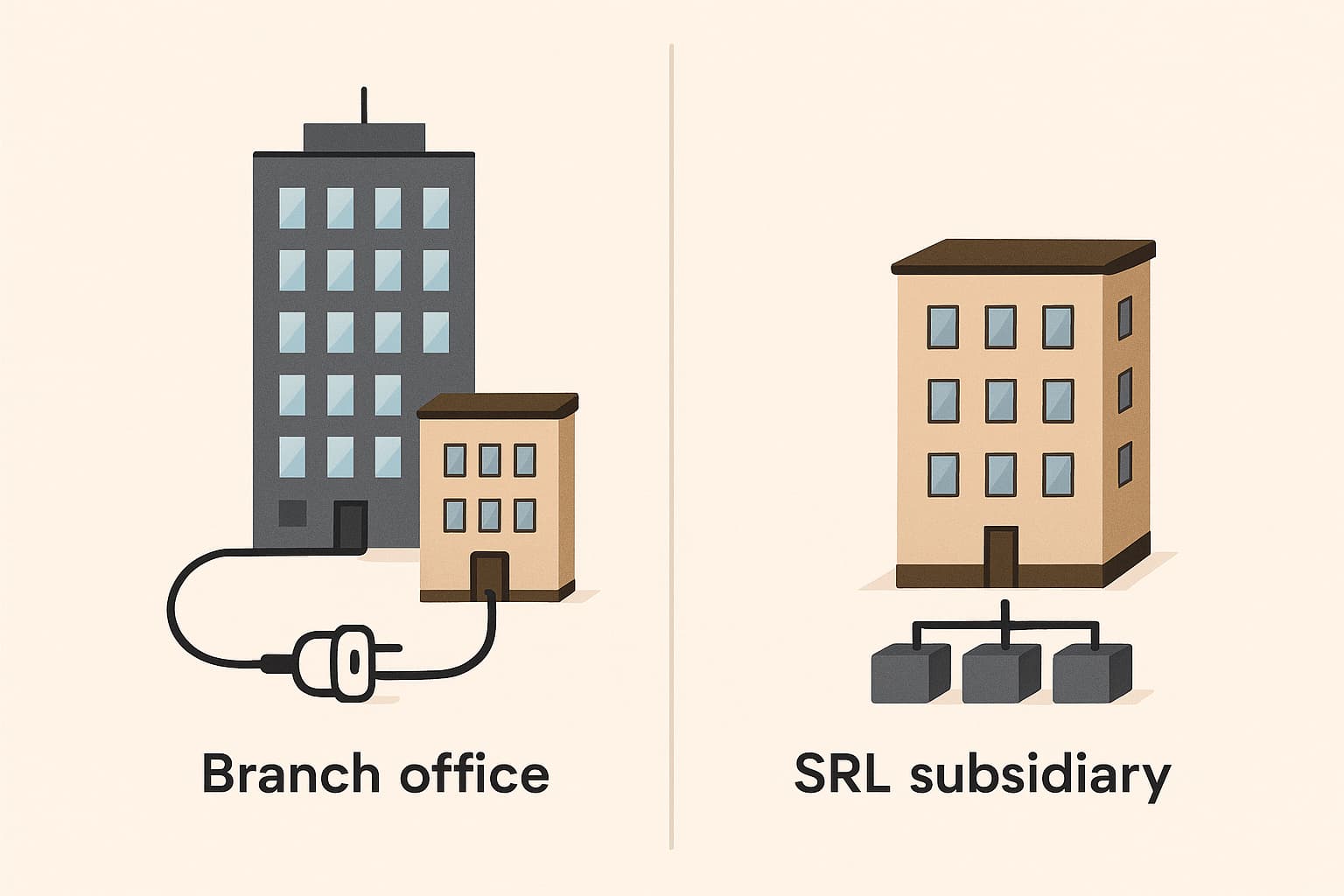
SRL vs Sole Proprietorship in Italy (2026): A Complete, Practical Comparison
Choosing between a Sole Proprietorship and an SRL (including SRLS) is one of the most consequential decisions when starting a business in Italy. Your choice affects personal liability, taxation, INPS contributions, paperwork and governance, bank and client perception, and ultimately your ability to scale.
This 2026 guide gives you a practical, side‑by‑side view—built for freelancers, founders, and expats—so you can decide with clarity and avoid costly re‑structures later.
TL;DR: A Sole Proprietorship is fast and inexpensive to start, but exposes you to unlimited personal liability. An SRL/SRLS shields personal assets through limited liability, supports team and financing, but requires more formalities and planning.
1) Sole Proprietorship in a Nutshell
A Sole Proprietorship is the simplest setup: you and the business are legally the same person. Key practical outcomes:
- Unlimited personal liability: business debts can reach your personal assets.
- Low start‑up cost and quick registration (often a few hundred euros all‑in for professional support, excluding municipal or sector‑specific permits).
- Personal taxation (IRPEF): business income is taxed under your personal bands (approx. 23%–43% plus regional/municipal add‑ons).
- Possible access to the Flat‑Rate Regime (Regime Forfettario) when eligible, with a 5% or 15% flat tax on a deemed base (coefficient‑based).
- Light compliance compared to a company—fewer corporate formalities.
Best for: very low‑risk activities, testing a business model, or lean freelancing with modest receipts and minimal supplier risk.
2) SRL and SRLS in a Nutshell
An SRL is a limited liability company: a separate legal entity. Practical implications:
- Limited liability: in general, shareholders’ risk is confined to the capital invested.
- Capital: a traditional SRL typically has a structured capital; the SRLS (simplified SRL) allows capital from €1 with a standard model deed and lower notary fees, but with statutory constraints.
- Corporate taxation: profits are taxed at the corporate level (IRES at 24% + potential IRAP), and dividends may later be taxed at the shareholder level under the rules in force.
- Governance: corporate books, annual accounts, shareholder meetings, and a higher level of ongoing formalities.
Best for: scaling, multiple founders, higher operational risk (contracts, inventory, team), client/finance perception, and long‑term growth.
3) Liability: Unlimited vs Limited
Sole Proprietorship: unlimited liability. If the business fails to meet obligations, creditors can target your personal assets. For many, this is the number one reason to avoid staying in this form as the business grows.
SRL/SRLS: limited liability. Liability is generally limited to the subscribed capital. Exceptions arise in cases like mismanagement, under‑capitalisation, improper mixing of personal and company funds, or personal guarantees given to banks or suppliers.
If you will sign substantial supply contracts, hire employees, or invest in assets, limited liability is frequently the rational long‑term choice.
4) Start‑Up Costs (2026)
Costs vary by city and sector, but practical ranges are:
- Sole Proprietorship: streamlined registration; chamber fees, duty stamps, any SCIA/permits. With professional support, a typical range is €150–€300 (plus taxes/permits as applicable).
- SRL: notary deed, chamber registration, duty stamps, model deeds, etc. The SRLS reduces notary costs with a standard statute. Budget €1,000–€2,500 in common scenarios; complex set‑ups can be more.
5) Running Costs and Paperwork
- Sole Proprietorship: simplified accounting; lower advisory fees; fewer corporate deadlines.
- SRL: annual accounts, corporate books, assembly minutes; more intensive compliance and typically higher advisory costs. On the other hand, this discipline builds sturdier processes for partners, banks, and due diligence.
6) Taxation: IRPEF vs IRES/IRAP
Sole Proprietorship
- Taxed under IRPEF progressive brackets on the business income you generate (plus regional/municipal add‑ons). You can use ordinary or simplified accounting, and if eligible, the Flat‑Rate Regime (Regime Forfettario).
- Under Forfettario: you do not deduct actual expenses; instead, you apply a sector‑specific profitability coefficient to gross receipts to compute a deemed taxable base. On that base you pay 5% (start‑ups) or 15% flat tax, subject to statutory conditions. You cannot recover input VAT under this regime.
SRL/SRLS
- Profits are taxed at the corporate level (e.g., IRES 24%), and IRAP may apply depending on activity/region. Later, dividends may be taxed at the shareholder level under current rules.
- You can deduct business expenses more extensively than under Forfettario and recover VAT on your inputs, which matters when you have significant costs or capital expenditure.
Heuristic: if your margins are thin and expenses minimal, the Flat‑Rate can be efficient. If you have higher margins and/or substantial deductible costs (team, gear, rent, software, logistics), an SRL often enables smarter tax planning and re‑investment.
7) INPS Social Contributions
Sole Proprietorship:
- You are typically in Artigiani/Commercianti (minimum fixed contributions + a percentage on income) or Gestione Separata for certain professional activities. Some reductions may be available for artisans/merchants (subject to online communication to INPS within deadlines).
SRL:
- The director (amministratore) pays Gestione Separata on compensation; working shareholders may fall under other INPS schemes depending on the role. We recommend mapping roles and compensation early to smooth cash flow and compliance over the year.
8) VAT and Invoicing
- Sole Proprietorship under Forfettario: you do not charge VAT; your invoices must carry the statutory non‑VAT reference. Record‑keeping is simpler, but you cannot deduct input VAT.
- SRL: ordinary VAT regime with the ability to recover input VAT—especially useful for e‑commerce, logistics, agency work with subcontractors, and capital investment cycles.
9) Banking, Financing, and Client Perception
Banks and corporate clients often prefer a company counterparty for governance, continuity, and control reasons. Even with an SRL, note that banks may still ask for personal guarantees on loans or credit lines—limited liability does not automatically remove all personal risk in financing.
If you deal with procurement teams, tenders, or mid‑market/enterprise B2B, operating as an SRL commonly improves acceptance ratios and negotiations.
10) Governance and Scale
Sole Proprietorship: you are the business—fast decisions, but less suited to adding partners or raising external capital. Transitions (succession, selling the business) are also less straightforward.
SRL: built for teams and investors—share quotas, shareholder agreements, capital increases, management roles. Better for equity incentives, structured contracts, and due diligence.
11) When to Convert (Sole Prop → SRL/SRLS)
Strong signals that it’s time to convert:
- Rising operational risk: larger contracts, inventory, or team hires.
- Receipts growing near Flat‑Rate thresholds; losing VAT recovery is increasingly costly.
- B2B requirements: bank, investor, or client policies requiring a company.
- Strategic hiring: you want to issue proper contracts, define management pay/dividends, and structure benefits.
Plan your conversion to avoid VAT and contract headaches—e.g., communicate with suppliers, update invoicing footprints, align INPS positions, and review lease or license clauses.
12) Practical Scenarios (2026)
Freelance Developer/Consultant (low expenses, 45–60k gross receipts):
- Start as a Sole Proprietorship under Forfettario for simplicity.
- Watch thresholds (85k) and pipeline. If client size and contract risk grow, plan a switch to SRL to ring‑fence personal assets and enable VAT recovery on equipment/training.
E‑commerce/Logistics (inventory, advertising, platforms):
- An SRL is usually more efficient thanks to VAT recovery and broader cost deduction. Liability protection also matters with suppliers and returns.
Creative/Marketing Agency (team‑based):
- SRL recommended for hiring, subcontracts, software stack, and equity options. Governance and perception add real commercial value.
Consultant with high travel/equipment expenses:
- If actual costs are material, the Flat‑Rate’s deemed base may be sub‑optimal; SRL can enhance net outcomes by recognising real costs and VAT.
13) Common Mistakes to Avoid
- Underestimating unlimited liability risk in a Sole Proprietorship.
- Staying too long in Flat‑Rate despite accumulating high non‑deductible costs.
- Incorporating an SRL without a plan for governance, accounting cadence, and cash flow.
- Neglecting INPS positioning and deadlines, causing penalties or cash crunches.
14) Decision Checklist
Use this quick list before you decide:
- Rate your operational risk (contracts, inventory, team, liabilities).
- Forecast receipts/margins and identify major costs (and whether you want VAT recovery).
- Check eligibility for Flat‑Rate and other incentives (e.g., impatriate regime).
- Consider client/bank perception relevant to your market.
- Define INPS strategy and management compensation/dividend policy.
- If converting, outline a timeline with supplier/client communication and compliance switches.
15) FAQs
Is SRLS always better than a traditional SRL?
No. SRLS lowers initial notary cost with a standard statute but has tighter constraints. If you foresee custom governance or future changes, a traditional SRL is often preferable.
Can I deduct more costs under an SRL than under the Flat‑Rate regime?
Yes. An SRL under the ordinary regime recognises real costs and recovers input VAT, while Forfettario applies a deemed base and does not allow VAT recovery.
Will banks still ask for personal guarantees if I own an SRL?
Often yes. Limited liability reduces exposure, but banks may require personal guarantees on loans—especially for early‑stage companies or thin capitalisation.
When does it make sense to start directly with an SRL?
If you face meaningful risk, plan B2B contracts, want to hire or bring in investors, or need the corporate image to win tenders and financing.
Useful Links and Next Steps
- Need to open a VAT number (Partita IVA)? Go to:
/services/open-vat-number-italy.
- Considering company formation (SRL)? Go to:
/services/open-company-italy.
- Are you an expat with tax questions? Go to:
/services/tax-accounting-expats.
Book a free consultation and we’ll map your risk, numbers, and goals, then recommend the right structure—and the right timing if a conversion makes sense.

 Giovanni Emmi|February 10, 2026