Starting a Business in Italy as a Foreigner: Structures, Taxes and Requirements 2026
Opening a business in Italy represents an extraordinary opportunity for many foreign entrepreneurs. Our country offers a dynamic market, interesting tax incentives, and increasingly simplified procedures. Whether you are a European citizen or a non-EU citizen, this guide will accompany you step by step towards the realization of your entrepreneurial project in 2026.
Coming from a specific situation?
Requirements for foreigners: EU vs non-EU
EU and EEA citizens can establish a business under the same company-law conditions as Italians. If they actually live in Italy for more than three months, they generally register with the municipal anagrafe under EU free-movement rules; they do not apply for a self-employment residence permit.
Two separate questions must then be kept apart:
- May the person or foreign entity own shares or incorporate? Share ownership does not itself grant a right to live or work in Italy. For a non-EU/EEA founder who is not covered by an exempt residence status, treaty or bilateral investment agreement, the notary may need to verify the condition of reciprocity for the specific act. This is a country- and act-specific check, not a blanket ban on foreign ownership.
- Will the founder move to Italy and work in the business? If so, a non-EU national needs the immigration route appropriate to the activity and status. Incorporating remotely under a power of attorney does not replace that permission.
Non-EU founders who intend to work in Italy
The ordinary self-employment route is governed principally by art. 26 of Legislative Decree 286/1998. It is generally subject to the applicable decreto flussi quota and requires the applicant to obtain the authorisations, resources and professional conditions relevant to the proposed activity before the consular visa application. The competent Chamber of Commerce may be involved in certifying the financial parameters for an activity, but it does not by itself issue a universal clearance for every case.
After entry with the correct visa, the residence-permit application must normally be filed within eight working days. The required file depends on the activity, regulated-profession rules, the competent consulate and the applicant's circumstances. It can include:
- passport and Italian tax code;
- business plan and evidence of sufficient resources;
- corporate or professional authorisations required for the activity;
- proof of accommodation and health cover where required;
- translations, apostilles or consular legalisation for the particular foreign documents requested.
Do not assume that every foreign document always needs both translation and apostille, or that the same financial threshold applies to every activity. Obtain the notary's and consulate's document list for the specific country and route.
The investor visa: a separate route
Italy's Investor Visa is a two-year visa for qualifying non-EU investors. The official programme currently lists:
- 250,000 euros in an Italian innovative startup;
- 500,000 euros in an Italian limited company;
- 2 million euros in Italian government bonds; or
- 1 million euros in a philanthropic initiative.
The application is filed on the government portal. The committee's nulla osta decision is normally due within 30 days, but the clock can be suspended if additional documents are requested; the consular visa decision is a separate stage. The investment is made after entry within the programme deadline. These timings are statutory or procedural targets, not a guarantee of the date on which the applicant can relocate.
Choosing the legal structure is a crucial decision for the success of your business. Each corporate form has specific advantages and disadvantages that you must carefully evaluate.
Sole proprietorship: simplicity and cost-effectiveness
The sole proprietorship remains the most economical solution to start. It does not require minimum capital, and the opening costs range between 150 and 300 euros if you rely on an accountant. However, you must consider that you will be personally liable for business debts, a significant risk.
Limited liability company: the most popular choice
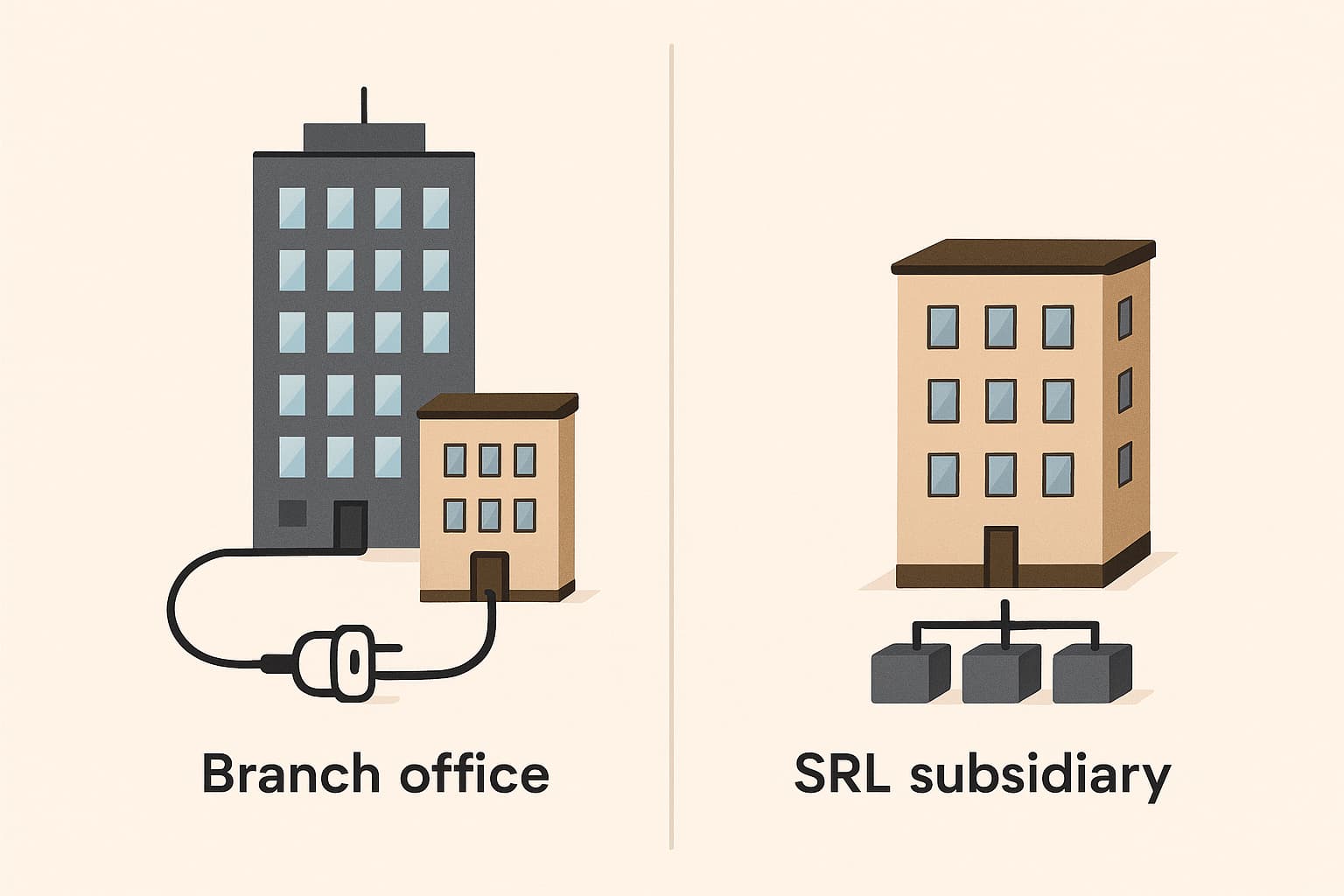
The SRL (Società a Responsabilità Limitata) is the most common limited-liability form for foreign founders. The standard statutory capital is 10,000 euros, but art. 2463 of the Civil Code permits capital from 1 euro. If capital is below 10,000 euros, it must be paid entirely in cash at incorporation and at least one fifth of annual net profit must be allocated to a special reserve until capital plus that reserve reaches 10,000 euros; the reserve may be used only for capitalisation or loss coverage and must be replenished if reduced. With capital of 10,000 euros or more, at least 25% of cash contributions is generally paid at incorporation; a sole-shareholder SRL must pay them in full (art. 2464). The ordinary 5% legal-reserve rule is not a substitute for the special low-capital rule.
Indicative total incorporation costs for a straightforward SRL are in the order of 2,500-3,000 euros, covering notary fees, registration taxes and accountant fees. Quotes vary with the capital chosen, the activity and the professional you engage, so treat any figure as an estimate rather than a price list.
🔍 Learn more: Discover all the details about SRL taxes and costs in Italy 2025 to better plan your budget.
Simplified SRL: the economical alternative
For those with limited budgets, the SRLS (Società a Responsabilità Limitata Semplificata) represents an interesting alternative. With capital from 1 to 9,999.99 euros — which must be paid in full in cash at incorporation — and incorporation costs below those of a tailor-made SRL (the deed uses the standard ministerial model, keeping notarial and public fees down), it offers many of the advantages of a traditional SRL. The trade-off is that the standard clauses of the model cannot be customised (art. 2463-bis, Italian Civil Code).
The most promising sectors for foreigners
Official business-demography data consistently shows that foreign entrepreneurs cluster in a few sectors, led by commerce, followed by construction and personal services. Many choose:
- clothing stores
- specialty food stores focusing on ethnic products
- import-export activities leveraging connections with their countries of origin
Construction firms often specialise in renovations incentivised by the building-bonus schemes, while personal services show steady growth, with particular success for:
- ethnic cuisine restaurants
- beauty centers
- domestic assistance services
📊 Source: sector shares and totals for foreign-owned businesses are published every year by Unioncamere and ISTAT (Unioncamere's Rapporto on immigrant entrepreneurship and ISTAT's business-demography releases); the balance shifts year by year, so check the latest edition before quoting a percentage.
Flat-rate scheme: check eligibility before choosing it
The regime forfettario applies to eligible individuals carrying on a business, art or profession; an SRL cannot use it. The ordinary revenue or compensation ceiling is 85,000 euros. For tax year 2026, Law 199/2025 keeps the prior-year employee and assimilated-income exclusion threshold at 35,000 euros, subject to the statutory exception where the employment relationship has ended.
The substitute-tax rate is normally 15% of the taxable income calculated under the regime's coefficient rules, not 15% of gross receipts in every case. The 5% rate applies for the first five tax periods only when all startup conditions in art. 1.65 Law 190/2014 are met:
- the taxpayer did not carry on any business, art or profession in the preceding three years, including through an association or family business;
- the new activity is not a mere continuation of earlier employment or self-employment, except for a mandatory professional-practice period; and
- if the activity continues one previously carried on by another person, that person's preceding-period revenue or compensation did not exceed the regime's ceiling.
Having a part-time job therefore does not automatically establish eligibility: all exclusion rules, the prior-year employment-income threshold and the startup conditions must be checked separately. Non-residents may use the regime only if resident in an EU or EEA state that provides adequate exchange of information and at least 75% of their total income is produced in Italy (art. 1.57(b), Law 190/2014).
💼 Learn more: Check out our complete guide on Partita IVA for foreigners in Italy 2026 to understand all tax advantages.
🌍 Planning to live in Italy? Read our guide on tax residency for expats in Italy to understand all tax implications.
Startup costs: plan your budget
Accurate financial planning is essential for the success of your business. Mandatory costs include:
- registration taxes: 200 euros
- stamps: 165 euros
- chamber fees: 90 euros
- PEC: 30-60 euros annually
In addition, there are accountant fees:
- from 150 euros for opening a simple VAT number
- up to 2,000 euros for the incorporation of an SRL
Don't forget bank costs:
- business current account: 10-50 euros monthly
- POS for electronic payments: 10-30 euros per month
These tools are now essential for any commercial activity.
How the incorporation process is organised
This guide is the strategic overview: which structure to choose, what it costs, which regime applies and who must do what. The operational sequence — documents, notary, Registro Imprese, VAT number, bank account — is set out step by step in our step-by-step guide to opening a company in Italy for foreigners. Here is the shape of it:
Document preparation
Only the foreign documents requested for the particular deed or application need the required form. Depending on the country, document and applicable convention, that may involve a certified translation, an apostille or consular legalisation. Ask the notary for a document-specific list before ordering translations.
Translation, apostille and legalisation charges vary by country, language, document and provider; obtain quotes rather than relying on a per-page figure.
This should be made in consultation with a specialized accountant, who will be able to advise you on the best solution for your specific situation.
Actual incorporation
- opening a VAT number
- registration with the Business Register
- registration with social security agencies
Final phase
- opening a business bank account
- activation of mandatory digital services
- obtaining specific authorizations for your sector
There is no statutory end-to-end formation time. A straightforward incorporation can move quickly once the notary has a complete file, while tax-code issuance, foreign-document formalities, regulated-activity approvals and especially bank KYC can extend the operational setup. Plan by dependency, not by a promised four-to-six-week date.
🚀 Need professional assistance to open a company in Italy? Our specialized team can guide you through every step of the process, from choosing the right corporate structure to complete registration. Book your free consultation today!
Want to learn more about starting a business in Italy? Check out our complete guide on how to start a business in Italy for foreigners 2025 with all the detailed steps and updated procedures.
Available incentives and financing
Italy offers numerous support tools for new businesses:
- New Businesses at Zero Interest: finances up to 90% of the investment for young people under 35 and women (max 1.5 million euros)
- regional programs: non-repayable contributions
Resto al Sud closed to new applications at 24:00 on 14 October 2025 and is not an available incentive for new applicants.
Innovative startups enjoy special benefits:
- exemption from stamp duties
- tax credits for research and development
- facilitated access to investment funds
Female entrepreneurship can rely on dedicated tools through the Fondo Impresa Donna.
Banking services for foreign entrepreneurs
Bank onboarding is a separate workstream from incorporation. Compare licensed providers on corporate-account eligibility, IBAN and payment needs, deposit protection, currencies, pricing and support. A provider that accepts one foreign ownership structure may reject another after KYC.
Prepare a transparent ownership chart, source-of-funds evidence, business plan, expected transaction flows and signed corporate documents. Online onboarding may be available, but no bank or adviser can promise approval or a fixed opening date.
🏦 Discover our services: We support business-account preparation for foreign founders, including coordination of the corporate and KYC file; the account decision remains the bank's.
Common mistakes to avoid
Experience shows that many foreigners make avoidable mistakes:
- documentation: ordering translations or legalisation before the notary confirms which form each foreign document needs, or omitting a required formality
- corporate strategy: choosing an inadequate corporate form or underestimating management costs
- taxation: failure to optimize available incentives or incorrect choice of tax regime
👉 A specialized accountant for foreign clients can make a difference in preventing these issues.
Frequently asked questions
Can a foreigner own 100% of an Italian SRL?
Yes, subject to the rules applicable to the founder. EU/EEA founders are treated like Italians for this purpose. For some non-EU/EEA founders or foreign corporate shareholders, the notary must verify reciprocity or an applicable exemption or treaty for the specific act. Ownership alone does not confer a visa, residence permit or right to work in Italy.
Is an Italian resident director mandatory?
There is no general company-law rule requiring every SRL director to reside in Italy. A non-resident director can create practical tax, service-of-process, banking and immigration issues, so the articles, management location and personal work authorisation should be reviewed before appointment.
What is the minimum capital for an SRL?
An SRL may be incorporated from 1 euro. Below 10,000 euros, all capital is paid in cash and at least 20% of annual net profit goes to the special reserve until capital plus reserve reaches 10,000 euros. At 10,000 euros or more, at least 25% of cash contributions is normally paid at incorporation, or 100% for a sole shareholder.
Can every new freelancer use the 5% forfettario rate?
No. It is limited to the first five tax periods and only if every startup condition is met, including no business, artistic or professional activity in the prior three years and no mere continuation of earlier work, apart from mandatory professional practice. The other forfettario entry and exclusion rules still apply.
How long does incorporation take?
There is no reliable universal duration. The notarial deed may be completed promptly once the file is ready, but tax codes, powers of attorney, foreign-document formalities, licences and bank onboarding can determine the real launch date.
Official sources
Conclusions
Opening a business in Italy as a foreigner is an ambitious but achievable project. Success depends on:
- careful preparation
- choosing the right legal and tax structures
- support from competent professionals
Italy offers a favorable ecosystem for foreign entrepreneurs, with significant incentives and increasingly digitalized procedures.
For the full roadmap, from choosing a legal structure to first-year obligations, see our complete guide to opening a company in Italy for foreigners.
The Italian market rewards those who can interpret local needs while maintaining their cultural specificities. With the right planning and determination, your entrepreneurial idea can become a success story in the Bel Paese.


 Giovanni Emmi|February 10, 2026