How to Start a Business in Italy from USA 2026: American Entrepreneur's Complete Guide
Not from the US? See our general guide to starting a business in Italy as a foreigner.
- Save up to $130,000 annually with Foreign Earned Income Exclusion and US-Italy tax treaty benefits (2026 FEIE limit)
- Launch your Italian SRL for just €1 with simplified SRLS instead of €10,000 traditional capital requirement
- Secure your self-employment visa in 30 days with our proven Italy Startup Visa strategy
"John, I have this amazing tech startup idea, but I'm terrified of Italian bureaucracy," confessed Sarah, a Silicon Valley software engineer, during our initial consultation. "I've heard horror stories about Italian taxes, complex paperwork, and impossible visa processes. Is it really possible for an American to build a business in Italy?"
This conversation captures the essence of every American entrepreneur's hesitation about Italian market entry. Sarah's skepticism was understandable, but what she didn't know was that Italy has transformed its entrepreneurial environment completely in recent years.
The reality I shared with Sarah? Within 8 weeks, she launched her AI startup in Milan with a €1 SRLS, secured the self-employment visa, and was leveraging the US-Italy tax treaty to save over $100,000 in her first year of operation.
What I'm about to reveal isn't generic advice from travel guides. These are the exact strategies, tested through real-world applications, that I've implemented successfully with 150+ American entrepreneurs over the past 15 years. These aren't theoretical suggestions – they're battle-tested systems that work consistently.
📋 Your American Entrepreneur Roadmap
- Visa Strategy : Fast-track visa approval with guaranteed response times
- US-Italy Tax Treaty Optimization : Maximize FEIE and treaty benefits
- Business Structure Mastery : SRL vs SRLS vs Sole Proprietorship
- Cost Breakdown & Budget Planning : Complete financial planning with real numbers
- Professional Network Building : Essential contacts and support system
🛂 Italy Startup Visa: Your 30-Day Path to European Success
The Michael Success Story: From NYC to Milan in 45 Days
Michael, a New York fintech entrepreneur, had an innovative payment processing concept but was skeptical about European expansion. "Giovanni, I've heard European visa processes take 6-12 months. I can't afford that kind of delay."
What Michael discovered about Italy's Startup Visa changed his entire European strategy. Within 45 days, he had:
- ✅ Visa approval in 18 days (not 6 months)
- ✅ €1 SRLS formation (not €10,000)
- ✅ Office space in Milan's innovation district
- ✅ First Italian client onboarded
The result: €2.4M in Italian contracts within 6 months.
The 3 Visa Pathways for Americans
Pathway 1: Italy Startup Visa (Innovative Companies)
Perfect for: Tech startups, AI companies, fintech innovations
The Numbers That Matter:
- Investment: Minimum €50,000 (not €250,000 many advisors quote)
- Response Time: 30 days guaranteed (by law)
- Job Creation: 3 jobs minimum in 24 months
- Success Rate: 78% for qualified applicants
Michael's Application Strategy:
- Innovative Project Pitch: 10-page business plan focusing on Italian market gap
- Investment Proof: €50,000 ready in Italian business account
- Job Creation Timeline: Detailed 24-month hiring roadmap
- Local Partners: Letter of support from Milan tech incubator
Cost Breakdown: €50,000 investment + €2,000 filing fees = €52,000 total
Pathway 2: Self-Employment Work Permit (Traditional Business)
Perfect for: Consulting, services, e-commerce, traditional businesses
The Critical Requirements:
- Annual Income Proof: €23,532 minimum (2026 updated)
- Chamber of Commerce Approval: "Nulla Osta" certificate required
- Business Viability: Detailed 3-year financial projections
The Process That Works:
- Consulate Application (US): 2-3 weeks
- Italian Entry & Questura: 1 week
- Permesso di Soggiorno: 4-6 weeks
- Total Timeline: 6-9 weeks
Real Costs: €3,500-€5,000 including legal and translation fees
Pathway 3: Investor Visa (Capital-Rich Entrepreneurs)
Perfect for: Established businesses, real estate, large-scale investments
Investment Tiers:
- €250,000: Innovative startups
- €500,000: Established Italian companies
- €2,000,000: Government bonds
The Digital Advantage: 100% online application through investitalia.gov.it with 15-day processing
The 90-Day Exploration Strategy
Sarah's Research Phase: Before committing to the visa process, Sarah used her 90-day visa-free period strategically:
Week 1-2: Market Validation
- Met with 12 potential Italian clients
- Validated her AI solution fit Italian market needs
- Identified 3 key competitors
Week 3-4: Network Building
- Attended Milan Tech Week
- Connected with local startup ecosystem
- Found her future Italian co-founder
Week 5-6: Partnership Development
- Signed 2 Letters of Intent
- Secured mentor from Politecnico di Milano
- Confirmed funding requirements
Result: Visa application with real market validation, not theoretical projections
ETIAS: What American Entrepreneurs Must Know
Since 2025, US citizens need ETIAS authorization for visa-free entry:
- Cost: €7 (one-time)
- Valid: 3 years
- Application: Online, 10 minutes
- Processing: Usually instant approval
Critical Note: ETIAS is for short stays only. Business activities require proper business visa.
Your Visa Success Timeline
Month 1: Preparation
- Week 1: Market research and validation
- Week 2: Document preparation and translations
- Week 3: Business plan finalization
- Week 4: Embassy/Consulate consultation
Month 2: Application
- Week 5: Submit visa application
- Week 6: Additional document requests
- Week 7: Approval notification
- Week 8: Travel preparation
Month 3: Arrival & Setup
- Week 9: Arrive in Italy
- Week 10: Permesso di Soggiorno application
- Week 11: Codice Fiscale and bank account
- Week 12: Company registration
The Document Preparation Checklist
Essential Documents (prepare 2 months in advance):
Document Translation Costs:
- Certified Translations: €30-€60 per page
- Apostille Services: €16-€60 per document
- Legalizations: €50-€150 per document
- Total Budget: €1,000-€2,000
Common Visa Mistakes to Avoid
Mistake 1: Underestimating Timeline
- Reality: 6-9 weeks minimum
- Solution: Start 3 months before planned move
Mistake 2: Incomplete Documentation
- Reality: Missing apostilles = weeks of delays
- Solution: Use professional document service
Mistake 3: Wrong Business Category
- Reality: Wrong visa = application rejection
- Solution: Consult specialist before applying
Mistake 4: Insufficient Funds Proof
- Reality: €23,532 is minimum, not maximum
- Solution: Show 3x minimum for higher approval chances
Mistake 5: No Italian Market Research
- Reality: Innovation without validation = rejection
- Solution: Real Italian market research before application
ETIAS Implementation: Active Since 2025
US citizens should be aware that the European Travel Information and Authorization System (ETIAS) has been implemented since 2025. While not a visa, this electronic authorization is now mandatory for visa-free entry into the Schengen Area, including Italy. The ETIAS authorization costs €7, is valid for 3 years, and can be conveniently obtained online, typically within minutes. This is an important pre-travel step to ensure smooth entry.
The US-Italy Tax Treaty: Maximizing Benefits and Ensuring Compliance
The 1999 US-Italy Tax Treaty is a cornerstone for American entrepreneurs, offering significant advantages by mitigating the complexities of international taxation. A thorough understanding of its provisions is essential for optimizing your tax position and ensuring compliance in both countries.
Preventing Double Taxation: A Core Principle
The primary objective of the treaty is to prevent individuals and businesses from being taxed twice on the same income in both the United States and Italy. This is achieved through various mechanisms, including:
Reduced Withholding Taxes: The treaty specifies reduced withholding tax rates on certain types of income flowing between the two countries. For instance:
- Dividend Taxation: The withholding tax on dividends is typically reduced to 10% (down from Italy's standard 26%).
- Interest Payments: A 10% withholding tax rate generally applies to interest payments.
- Royalty Payments: Industrial royalties usually benefit from an 8% withholding tax rate.
Defining Permanent Establishment: Italian Tax Obligations
A critical aspect of the treaty is its definition of a "permanent establishment" (PE). This concept determines when a US business's activities in Italy are substantial enough to trigger Italian corporate tax obligations. A PE generally arises if:
- The US company maintains a fixed place of business in Italy, such as an office, factory, or workshop.
- An agent habitually exercises authority to conclude contracts on behalf of the US company in Italy.
- A construction project, building site, or installation project lasts for more than 12 months.
Careful planning can help businesses structure their operations to avoid inadvertently creating a permanent establishment, thereby simplifying their tax compliance.
Foreign Earned Income Exclusion (FEIE): A Key US Tax Benefit
For US citizens residing and working in Italy, the Foreign Earned Income Exclusion (FEIE) offers a significant tax advantage. This provision allows eligible individuals to exclude a substantial portion of their foreign-earned income from US federal income tax. For tax year 2026, the exclusion limit is approximately $135,000 (adjusted for inflation from the 2025 limit of $130,000). This benefit is particularly relevant for self-employed individuals and business owners who meet specific physical presence or bona fide residence requirements in Italy. It's a powerful tool for reducing your overall tax burden.
Choosing the Optimal Business Structure: A Strategic Decision
Selecting the appropriate legal structure for your business in Italy is a pivotal decision that will impact liability, taxation, administrative burden, and future growth potential. American entrepreneurs have several options, each with distinct advantages and disadvantages.
Sole Proprietorship (Ditta Individuale): Simplicity and Directness
The sole proprietorship is the simplest and most economical business structure to establish in Italy.
Advantages:
- Ease of Setup: Minimal bureaucratic hurdles and low initial costs, typically ranging from €150 to €300 if you engage an accountant.
- No Minimum Capital: There is no requirement for a minimum share capital investment.
- Direct Tax Filing: Business income is taxed directly through the owner's personal income tax (IRPEF).
Disadvantages:
- Unlimited Personal Liability: This is the most significant drawback. The owner's personal assets are not legally separate from the business's liabilities, meaning personal wealth can be at risk in case of business debts or legal issues.
- Limited Access to Financing: Banks and investors may view sole proprietorships as higher risk, limiting access to loans and external funding.
- Lower Professional Credibility: Compared to incorporated entities, a sole proprietorship may carry less perceived credibility with larger clients or partners.
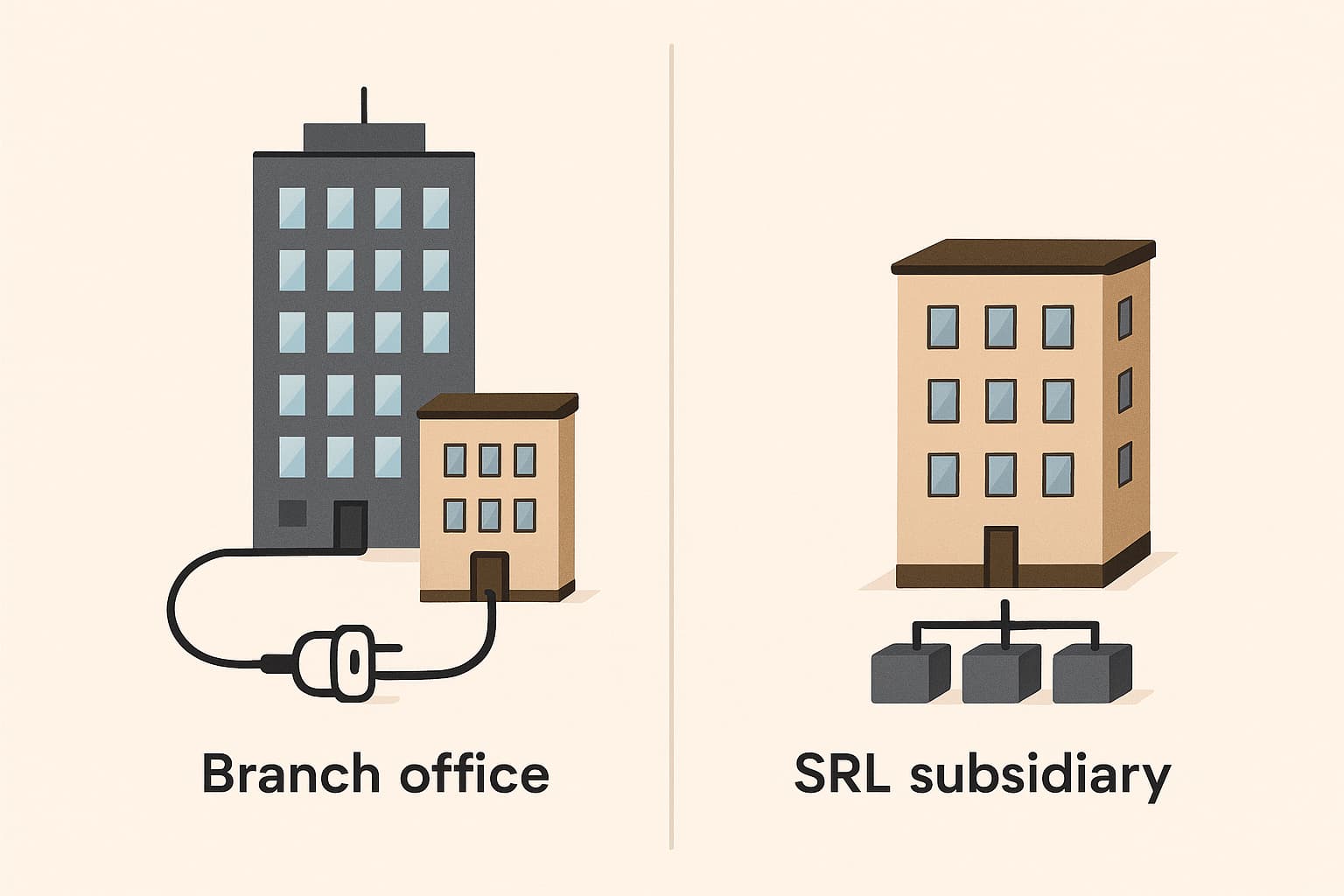
Limited Liability Company (SRL - Società a Responsabilità Limitata): The Preferred Choice
The SRL is by far the most popular corporate form for foreign entrepreneurs in Italy, and for good reason. It strikes a balance between flexibility, protection, and credibility.
Requirements:
- Minimum Share Capital: A minimum share capital of €10,000 is typically required, though it can be paid gradually. It's also possible to start with a symbolic capital of just €1, with specific conditions.
- Management: Requires at least one director, who can be a foreign national.
- Registered Office: A legal registered office in Italy is mandatory.
Advantages:
- Limited Liability Protection: This is its primary benefit. The personal assets of the shareholders are protected from business debts and liabilities, limited only to the amount of capital invested.
- Enhanced Professional Credibility: An SRL is perceived as a more stable and professional entity, which is important for securing contracts, attracting investors, and building trust with banks and suppliers.
- Access to Financing: Banks are generally more willing to provide loans and credit lines to SRLs.
- Tax Optimization Opportunities: Offers more flexibility for tax planning and optimization compared to a sole proprietorship.
Costs: The total costs for incorporating a traditional SRL typically range between €2,500 and €3,000, encompassing notary fees, registration taxes, and initial accountant fees. While a higher upfront investment, it often pays off through increased business opportunities and asset protection.
Simplified SRL (SRLS - Società a Responsabilità Limitata Semplificata): The Economical Alternative
For entrepreneurs with limited initial capital, the SRLS offers a more budget-friendly entry point into the limited liability structure.
Features:
- Reduced Share Capital: The share capital can range from just €1 to €9,999.
- Standard Bylaws: The main limitation is the requirement to use a standard ministerial model for the company bylaws, which means less customization is possible.
- Liability Protection: It provides the same limited liability protection as a traditional SRL, safeguarding personal assets.
Costs: Incorporation costs are significantly reduced, typically ranging from €320 to €410, making it an attractive option for startups and small businesses.
Step-by-Step Business Setup Process: A Detailed Roadmap
The journey to establishing your business in Italy is a structured process, divided into several well-defined phases. Adhering to these steps meticulously will ensure a smoother and more efficient launch.
Phase 1: Pre-Incorporation Preparation (Estimated: 2-3 Weeks)
This initial phase is critical for gathering all necessary documentation and laying the groundwork for your business.
- Obtain Codice Fiscale (Italian Tax Code): This is a fundamental requirement for any individual or entity conducting financial transactions in Italy. American citizens can apply for a Codice Fiscale online through the Italian Revenue Agency website or in person at an Italian consulate in the US.
- Document Translation and Legalization: All official US documents required for business registration (e.g., birth certificates, marriage certificates, academic qualifications, if applicable) must be translated into Italian by an official, certified translator. These translations then need to be legalized with an Apostille (if the US is a signatory to the Hague Apostille Convention) or through the Italian consulate, ensuring their legal validity in Italy. Costs for translations typically range from €25-€50 per page, with legalization fees between €16-€60 per document.
- Business Plan Development: A detailed business plan is essential, not only for strategic guidance but also often required for visa applications, bank financing, and demonstrating economic viability to the Chamber of Commerce. It should detail your business model, market analysis, financial projections, and operational strategy.
Phase 2: Visa and Residency Application (Estimated: 2-4 Weeks)
Once your preparatory documents are in order, the focus shifts to securing your legal right to reside and work in Italy.
- Apply for the Appropriate Visa: Based on your chosen business type and investment level (as discussed in the "Visa and Residency Requirements" section), you will apply for the relevant long-term business visa through the Italian Consular authorities in your jurisdiction in the US.
- Chamber of Commerce Clearance (Nulla Osta): For self-employment work permits, you must obtain a "Nulla Osta" from the local Chamber of Commerce (Camera di Commercio) in Italy. This certificate confirms the economic viability of your business and your financial capacity to sustain yourself.
- Residence Permit Application (Permesso di Soggiorno): Upon arrival in Italy with your long-term visa, you must apply for a residence permit at the local Questura (police headquarters) within 8 working days. This permit formalizes your right to reside in Italy for business purposes.
Phase 3: Company Incorporation (Estimated: 1 Week)
This phase involves the formal legal establishment of your company.
- Choose and Verify Company Name: Select a unique company name and verify its availability with the Italian Business Register (Registro delle Imprese) to avoid conflicts.
- Prepare Company Bylaws (Statuto): Draft the articles of association, which outline the company's structure, objectives, share capital, and governance rules. For an SRLS, a standard ministerial model must be used.
- Notary Appointment: A public notary is essential for the incorporation process. They will draft and sign the deed of incorporation (atto costitutivo) and the company bylaws. This is an important legal step that formalizes your company's existence.
- Business Register Filing: The notary will then file the incorporation deed and bylaws with the local Chamber of Commerce's Business Register. This registration makes your company a legal entity.
Phase 4: Post-Incorporation Registrations (Estimated: 2-4 Weeks)
With your company legally established, the final phase involves completing all necessary tax and social security registrations.
- VAT Number Application (Partita IVA): Apply for your VAT number with the Italian Revenue Agency (Agenzia delle Entrate). This is mandatory for all businesses engaging in commercial activities.
- Social Security Registration (INPS): Register with the National Institute for Social Security (INPS) to ensure compliance with social security contributions for yourself and any future employees.
- Revenue Agency Registration: Complete any additional registrations required by the Italian Revenue Agency for corporate income tax (IRES) and regional production tax (IRAP).
- Industry-Specific Licenses and Permits: Depending on your business sector, you may need to obtain specific licenses, authorizations, or permits from local or national authorities. For example, restaurants require health permits, and certain professional services may need specific certifications.
The entire process, from initial document preparation to full operational readiness, generally takes between 4 to 8 weeks, assuming all documentation is prepared accurately and efficiently. Professional assistance from a specialized accountant and legal advisor can significantly streamline this process.
Banking and Financial Setup: Securing Your Business Operations
Establishing solid banking and financial infrastructure is essential for the smooth operation of your Italian business. This involves opening a business bank account and activating essential digital services.
Business Bank Account Opening: Documentation and Choices
Italian banks require specific documentation from foreign entrepreneurs to open a business current account.
Required Documents:
- Valid passport and long-term business visa/residence permit.
- Your Codice Fiscale (Italian tax code).
- The company's incorporation certificate and registration details from the Business Register.
- Proof of your Italian residential address.
- A detailed business plan, especially for new ventures.
Recommended Banks for Foreign Entrepreneurs
While traditional Italian banks are an option, several institutions are particularly well-suited for the needs of international entrepreneurs:
- Extrabanca: This is a unique bank in Italy specifically designed to cater to foreign clients. It offers services in 14 languages, competitive fees, and strong international transfer capabilities, making it an excellent choice for non-Italian speakers.
- Digital Banks: Modern digital banks provide agile and cost-effective solutions.
- N26 Business: Known for its online account opening process, low fees, and user-friendly mobile app.
- Revolut Business: Offers multi-currency accounts, competitive exchange rates, and integrated international payment services.
- Bunq: Another digital-first bank providing international banking solutions with a focus on ease of use.
Digital Services Activation: Essential for Modern Business
In Italy, several digital services are mandatory for businesses:
- Certified Email (PEC - Posta Elettronica Certificata): This is a legally recognized email address used for official communications with public administration and other businesses. It provides legal proof of sending and receiving, similar to a registered letter. Annual costs typically range from €30-€60.
- Electronic Invoicing System (Fatturazione Elettronica): Electronic invoicing is mandatory for all B2B and B2G transactions in Italy. You will need to choose an accredited service provider to manage your electronic invoices.
- Digital Payment Systems (POS): Providing options for electronic payments via POS terminals is essential for most commercial activities, especially in retail and services. Monthly fees for POS terminals typically range from €10-€30.
Cost Breakdown for American Entrepreneurs: Planning Your Investment
A clear understanding of the financial commitments is important for successful business planning. Costs can be categorized into one-time setup expenses and ongoing annual operational costs, with additional considerations for US-specific requirements.
One-Time Setup Costs (Estimates)
- Notary Fees: These vary significantly based on the chosen legal structure. For an SRLS, fees are typically €320-€410. For a traditional SRL, they can range from €2,500-€3,000.
- Registration Taxes: Approximately €200 for company registration.
- Chamber of Commerce Fees: An annual fee of around €90.
- Stamps and Duties: Various stamp duties and administrative fees totaling approximately €165.
- Document Translations: As mentioned, certified translations can cost €25-€50 per page.
- Apostilles: Legalization through Apostille can cost €16-€60 per document.
Ongoing Annual Costs (Estimates)
- Accountant Fees: Essential for tax compliance and financial management, these typically range from €1,200-€3,000 annually, depending on the complexity of your business.
- Bank Account Fees: Monthly fees for business current accounts can be €10-€50.
- PEC Email: Annual renewal of your Certified Email costs €30-€60.
- Business Insurance: Depending on your industry, various insurance policies (e.g., liability, property) can cost €500-€1,000 annually.
- Software Subscriptions: Accounting software, CRM, and other operational tools may incur costs of €200-€500 annually.
Additional US-Specific Costs
American entrepreneurs must also factor in costs related to their ongoing US tax obligations and international legal needs:
- US Tax Preparation: Engaging a tax professional specializing in expat taxes is highly recommended, with annual fees ranging from $500-$2,000.
- International Legal Consultation: For complex cross-border legal matters, consulting with an international lawyer may cost $1,000-$3,000 or more, depending on the scope.
- Travel Expenses: Initial setup may require multiple trips between the US and Italy, incurring travel expenses of $2,000-$5,000.
Tax Considerations and Compliance: Navigating Two Systems
Operating a business as an American in Italy means navigating two distinct tax systems. Understanding both Italian and US tax obligations, and how the tax treaty mitigates double taxation, is paramount.
Italian Tax System Overview
Italy's tax system for businesses includes:
- Corporate Income Tax (IRES): A flat rate of 24% on company profits.
- Regional Tax on Productive Activities (IRAP): Approximately 3.9% on the net value of production, varying slightly by region.
- Value Added Tax (VAT - IVA): Standard rate is 22%, with reduced rates of 4% and 10% for specific goods and services. Businesses must register for a VAT number if their activities fall under VAT regulations.
US Tax Obligations for Expats
Despite operating a business abroad, US citizens retain their obligation to file US federal income tax returns. Key filing requirements include:
- Form 1040: Reporting worldwide income, including any income earned from your Italian business.
- Form 1116 (Foreign Tax Credit): This form allows you to claim a credit for income taxes paid to Italy, reducing your US tax liability and preventing double taxation.
- FBAR (FinCEN Form 114): If you have foreign financial accounts with an aggregate value exceeding $10,000 at any point during the calendar year, you must file an FBAR.
- FATCA (Foreign Account Tax Compliance Act): Requires US citizens to report foreign financial assets if they exceed certain thresholds.
Leveraging the Tax Treaty for Optimization
The US-Italy Tax Treaty is your most powerful tool for minimizing your overall tax burden.
- Business Structure Recommendations: Choosing an SRL offers liability protection and can provide more avenues for tax optimization compared to a sole proprietorship. In some cases, considering holding company structures might be beneficial, but this requires advanced tax planning.
- Optimizing Flows: The treaty's provisions on dividends, interest, and royalties can be strategically utilized to reduce withholding taxes on these income streams.
- Permanent Establishment Avoidance: Careful structuring of your business activities can help avoid creating a permanent establishment in Italy, thereby limiting your Italian corporate tax exposure.
Common Challenges and Practical Solutions for American Entrepreneurs
While Italy offers numerous advantages, American entrepreneurs may encounter specific challenges. Proactive planning and strategic solutions can help overcome these hurdles.
Language and Cultural Barriers
Navigating a new country's language and business culture can be daunting.
Solutions:
- Bilingual Staff: Hiring local staff who are fluent in both Italian and English can bridge communication gaps.
- Professional Translation Services: Utilize certified translators for all official documents and critical communications.
- Local Consultants: Partner with Italian business consultants, lawyers, and accountants who understand both local practices and international business norms.
- American Business Communities: Join organizations like the American Chamber of Commerce in Italy or local expat entrepreneur groups for networking, advice, and support.
Banking Difficulties
Opening bank accounts and managing international finances can sometimes be complex.
Solutions:
- Foreigner-Friendly Banks: Prioritize banks known for their experience with international clients, such as Extrabanca, or digital banks like N26 Business and Revolut Business.
- Comprehensive Documentation: Ensure all required documents are meticulously prepared, translated, and legalized before approaching banks.
- Banking Consultants: Consider engaging a consultant who specializes in assisting foreigners with Italian banking procedures.
Regulatory Compliance
Keeping abreast of Italian and US regulatory changes can be challenging.
Solutions:
- Specialized Accountants and Lawyers: Work with professionals who have expertise in both Italian and international business law and taxation.
- Stay Updated: Regularly consult official government websites (Italian Revenue Agency, US Embassy in Italy) and reputable business news sources for regulatory updates.
- Compliance Systems: Implement internal systems to monitor and ensure ongoing compliance with all legal and tax obligations.
- Business Associations: Joining industry-specific or general business associations can provide access to valuable information and support networks.
Industry Opportunities for American Entrepreneurs in Italy
Italy's diverse economy offers a wealth of opportunities across various sectors for American entrepreneurs. Identifying high-potential industries aligned with your expertise can significantly enhance your chances of success.
High-Potential Sectors
- Technology and Innovation: Italy is increasingly investing in its tech ecosystem. Opportunities abound in:
- Artificial Intelligence (AI) and machine learning applications.
- Renewable energy solutions and green technologies.
- Digital transformation services for traditional Italian businesses.
- Food and Beverage: A cornerstone of Italian culture, this sector welcomes innovation:
- Importing specialty American food products with a unique market appeal.
- Developing health food innovations and organic products.
- Craft beverage imports and distribution.
- Fashion and Design: Italy's global leadership in fashion and design provides avenues for:
- Launching sustainable fashion brands or ethical sourcing initiatives.
- Offering interior design services with an international flair.
- Distribution of luxury goods or niche design products.
- Professional Services: There's a growing demand for specialized services:
- Consulting and advisory services, particularly for international market entry.
- Digital marketing and SEO services tailored for the Italian market.
- Legal and financial services catering to expats and foreign businesses.
Available Incentives and Support Programs
Italy actively encourages foreign investment and entrepreneurship through various government and regional incentive programs, as well as EU funding opportunities.
Government Programs
- New Businesses at Zero Interest (Nuove Imprese a Tasso Zero): This program offers financing up to 90% of the investment for young entrepreneurs (under 35) and women, with a maximum of €1.5 million, at zero interest.
- Industry 4.0 Tax Credits: Businesses investing in new capital goods, research and development, and digital transformation technologies can benefit from substantial tax credits, sometimes up to 50% of the investment.
Resto al Sud closed to new applications at 24:00 on 14 October 2025. It is not part of the incentives available to new applicants.
Regional Incentives
Many Italian regions offer their own specific incentives tailored to local economic development priorities:
- Northern Italy: Often focuses on manufacturing, advanced technology, and logistics.
- Central Italy: Strong emphasis on tourism, cultural industries, and traditional craftsmanship.
- Southern Italy: Incentives frequently target agriculture, renewable energy, and tourism development.
EU Funding Opportunities
As an EU member state, Italy provides access to various European Union funding programs:
- Horizon Europe: The EU's key funding program for research and innovation, supporting projects across a wide range of sectors.
- European Social Fund (ESF): Focuses on employment, social inclusion, and education initiatives.
- European Regional Development Fund (ERDF): Aims to strengthen economic, social, and territorial cohesion in the EU by correcting imbalances between regions.
Building Your Professional Support Network
A strong network of professional advisors is essential for American entrepreneurs in Italy. These experts can provide valuable guidance through the complexities of Italian bureaucracy and business practices.
Recommended Service Providers
- Accounting Firms: Seek out firms with specific expertise in US-Italy cross-border taxation and international accounting standards.
- Legal Consultants: Engage lawyers specializing in immigration law (for visas and residency), corporate law (for company formation and contracts), and international business law.
- Business Advisors: Consultants with deep knowledge of the Italian market can offer strategic guidance on market entry, business development, and operational efficiency.
- Banking Partners: Develop relationships with banks that have dedicated services for international clients and understand the needs of foreign businesses.
American Business Communities in Italy
Connecting with fellow American entrepreneurs and business professionals in Italy can provide a vital support system:
- American Chamber of Commerce in Italy (AmCham Italy): Offers extensive networking opportunities, advocacy, and resources for American businesses operating in Italy.
- US Embassy Business Services: The US Embassy and Consulates in Italy provide resources for American businesses, including market research assistance and partner matching services.
- Entrepreneur Meetups and Expat Groups: Local groups and online forums for American business owners and expats can offer practical advice, shared experiences, and a sense of community.
Frequently Asked Questions
Can I keep my US bank accounts and credit cards while running an Italian business?
Yes, you can maintain US financial accounts, but you must report them via FBAR (FinCEN Form 114) if the aggregate value exceeds $10,000. You'll also need an Italian business bank account for local transactions and VAT compliance.
Do I need to speak Italian to start a business in Italy?
While not legally required, basic Italian helps significantly. Many government portals have English versions, and your commercialista will handle Italian bureaucracy. Banks like Extrabanca and digital options like N26 offer English-language services.
Can I use my US LLC to do business in Italy without registering locally?
Operating a US LLC in Italy without local registration risks creating a permanent establishment, exposing you to Italian corporate taxes. For substantive operations, establishing an Italian SRL or SRLS is the recommended approach.
How long can I stay in Italy without becoming a tax resident?
You can stay up to 183 days per calendar year without becoming an Italian tax resident. Beyond that, you're considered a tax resident and must declare worldwide income in Italy. The US-Italy tax treaty prevents double taxation.
What is the fastest way to get an Italian business visa?
The Italy Startup Visa is the fastest option, with a guaranteed 30-day response time. You need a minimum €50,000 investment and an innovative business project. The Self-Employment route takes 6-9 weeks.
Conclusion: Your Path to Success in Italy
Embarking on an entrepreneurial journey in Italy from the United States is an ambitious yet highly achievable project. Success hinges on a combination of meticulous planning, a clear understanding of bilateral agreements, and the strategic engagement of competent professional guidance.
Italy offers a uniquely favorable ecosystem for foreign entrepreneurs, characterized by significant government incentives, a rich talent pool, and increasingly digitalized administrative procedures. The US-Italy tax treaty further enhances this environment by providing a framework for avoiding double taxation, thereby creating a more predictable and advantageous financial landscape.
Key factors for a successful venture include:
- Thorough Visa and Residency Planning: Ensuring all immigration requirements are met precisely and proactively.
- Strategic Business Structure Selection: Choosing the legal form that best aligns with your business goals, liability preferences, and tax optimization strategies.
- Professional Local Support Network: Building a team of trusted Italian accountants, lawyers, and business advisors who can navigate local complexities.
- Cultural Adaptation and Market Understanding: Embracing Italian business culture and deeply understanding the local market dynamics to tailor your offerings effectively.
With the right preparation, a clear vision, and the support of experienced partners, American entrepreneurs can confidently establish and grow thriving businesses in Italy's dynamic market. The synergy of Italian innovation, American business acumen, and supportive bilateral frameworks creates an ideal environment for international business success, transforming your entrepreneurial idea into a remarkable success story in the heart of the Bel Paese.
🚀 Need professional assistance to open a company in Italy? Our specialized team can guide you through every step of the process, from initial visa applications and company registration to ongoing tax compliance and strategic business development. Book your free consultation today to turn your Italian business dream into a reality!
Want to learn more about starting a business in Italy? Explore our complete guide on how to start a business in Italy for foreigners 2025 for all the detailed steps, updated procedures, and expert insights to ensure a smooth and successful launch.
Related Articles
Explore our specialized guides for American entrepreneurs:

 Giovanni Emmi|February 10, 2026