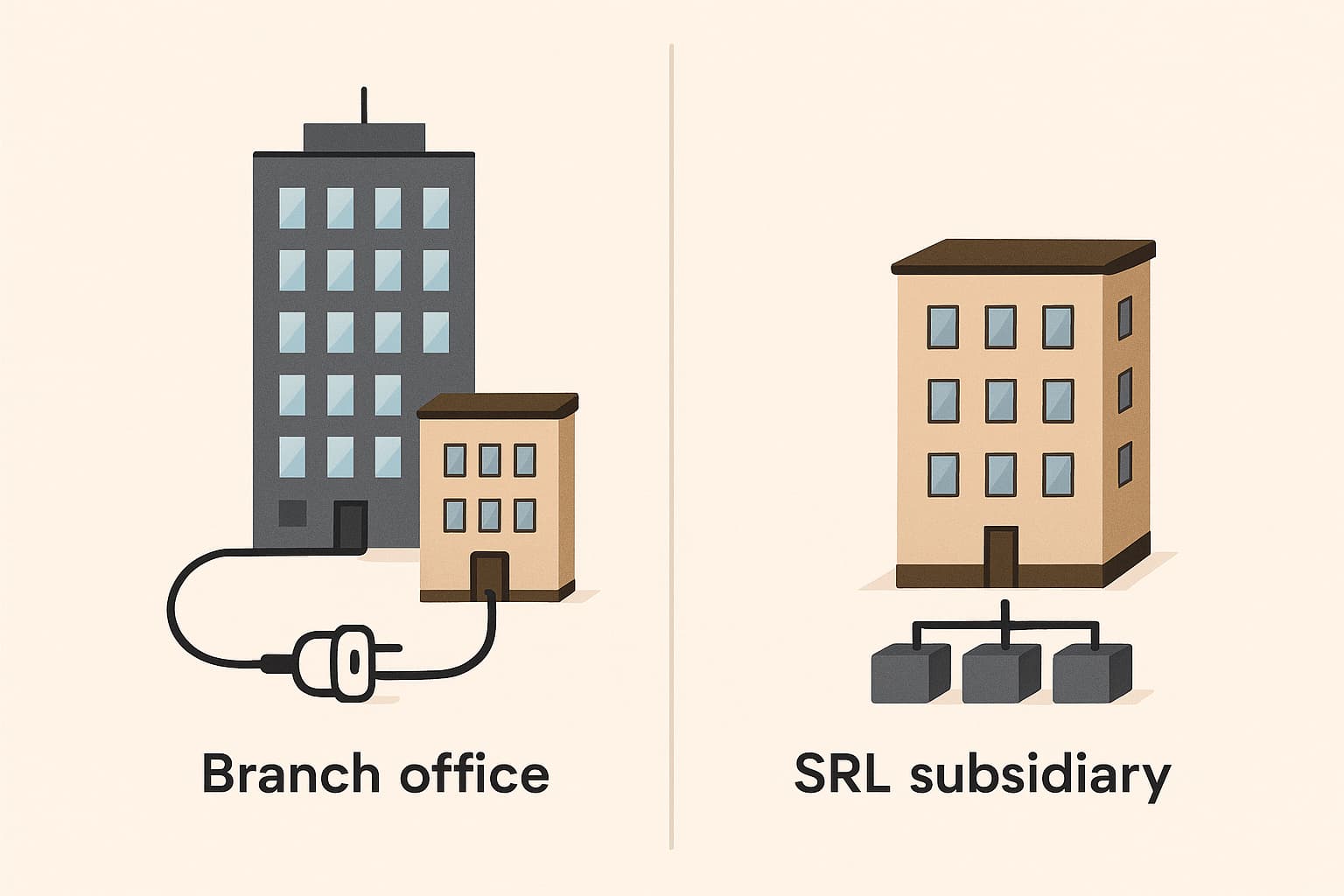
Cost to Open a Company in Italy: Real Breakdown 2026
Planning to open a company in Italy? Understanding the real costs involved is essential for proper financial planning. This guide provides a complete breakdown of all expenses—from incorporation to ongoing operations—so you can make informed decisions and avoid unexpected financial surprises. Whether you are considering a sole proprietorship, an SRLS, or a full SRL, knowing the numbers upfront helps you choose the right structure for your situation. For a broader overview of the incorporation process itself, see our complete guide to opening a business in Italy as a foreigner.
Company Structure Options and Their Costs
Italy offers several business structures, each with different cost implications. The choice affects not only initial setup costs but also ongoing administrative expenses and tax obligations. Your decision should factor in your expected revenue, the level of liability protection you need, and whether you plan to hire employees.
Sole Proprietorship (Impresa Individuale)
The simplest and cheapest option for individual entrepreneurs. Your personal and business assets remain legally intertwined, meaning you are personally liable for business debts. This structure suits small operations, freelancers, and consultants who do not need limited liability protection. If you are exploring this route, our Partita IVA guide for foreigners covers the registration steps in detail.
Initial Costs:
- Business registration (Camera di Commercio): €50-100
- Partita IVA registration: Free
- Optional: Certified accountant (commercialista) setup: €500-1,000
- Total initial: €50-1,100
Ongoing Annual Costs:
- Camera di Commercio renewal: €50-150
- Accountant (if used): €1,000-2,500
- Accounting software: €150-400
- Total annual: €1,200-3,050
SRLS (Società a Responsabilità Limitata Semplificata)
The simplified limited liability company was created specifically to reduce barriers to entrepreneurship. It requires no notary deed if the share capital is under €10,000, making it significantly cheaper than a traditional SRL. As a natural person, you can be the sole shareholder and sole director simultaneously. If the sole shareholder is a legal entity (another company), a separate director must be appointed.
Initial Costs:
- Share capital (minimum €1): €1-10,000
- Business registration (Camera di Commercio): €100-200
- Online registration via Agenzia delle Entrate: Free
- Legal/statutory documents (if using template): €300-800
- Accountant setup: €800-1,500
- Total initial: €1,200-12,500
Ongoing Annual Costs:
- Camera di Commercio: €150-300
- Accountant: €2,000-4,000
- Accounting software: €300-600
- Social security (INPS): €4,000-8,000+ (if director)
- Total annual: €6,450-12,900
SRL (Società a Responsabilità Limitata)
The standard limited liability company requires a notary deed and provides full legal protection and credibility. This is the most common structure for serious business operations in Italy, particularly when dealing with Italian corporate clients or seeking bank financing. For a deeper comparison of structures, see our SRL vs sole proprietorship analysis.
Initial Costs:
- Share capital (minimum €1): €1-10,000
- Notary fees: €1,500-4,000 (varies by complexity)
- Business registration: €200-400
- Legal/statutory documents: €1,000-2,500
- Accountant setup: €1,500-3,000
- Total initial: €4,200-19,900
Ongoing Annual Costs:
- Notary (annual deeds if needed): €500-2,000
- Camera di Commercio: €200-400
- Accountant: €3,000-6,000
- Accounting software: €400-800
- Social security (INPS): €4,000-8,000+ (if director)
- Total annual: €8,100-17,200
SRL Startup (SRL Startup Innovativa)
For technology and innovative businesses, Italy offers special startup status with benefits including flexible equity compensation, crowdfunding through special portals, tax credits for R&D activities, and extended loss carry-forward.
Initial Costs:
- Same as standard SRL plus additional documentation
- Business plan and innovation documentation: €500-2,000
- Startup status application: €200-500
Detailed Cost Breakdown by Category
Notary Fees
Notary costs represent the largest single expense for SRL formation. Fees depend on:
- Company type and complexity: SRLS slightly cheaper than SRL
- Share capital amount: Higher capital slightly increases fees
- Structural complexity: Multiple shareholders, atypical governance, real estate involvement
- Notary location: Notaries in Milan, Rome, and Florence charge 20-40% more
Typical ranges:
- SRL with €1 share capital: €1,200-2,000
- SRL with €10,000 share capital: €1,500-3,000
- SRL with €50,000+ share capital: €2,500-6,000
- Additional clauses or special provisions: €300-1,000 each
Registration Fees
Camera di Commercio (Business Register):
- Initial registration: €100-200
- Annual renewal: €150-400
- Additional filings: €50-150 each
Agenzia delle Entrate (Tax Authority):
- Partita IVA: Free
- Registration for VAT (if needed): Free
Professional Services
Commercialista (Certified Accountant):
- One-time setup: €800-3,000
- Annual accounting and tax filing: €2,000-6,000
- Payroll services (per employee): €300-600/year
Lawyer (for complex situations):
- Contract review: €500-2,000
- Due diligence: €2,000-10,000+
- Litigation (if needed): €5,000+
Hidden and Often Overlooked Costs
Deposit Requirements
If you are not physically present in Italy, many banks require:
- Initial deposit: €5,000-50,000 (refundable after operations begin)
- Proof of funds: Bank statements showing capital availability
Italian Bank Account
Business accounts often have higher fees than personal accounts. Our guide to opening a bank account in Italy walks you through the process:
- Opening fee: €0-200
- Monthly maintenance: €15-50
- Transaction fees: €1-5 per transaction
- International transfers: €15-50 each
Digital and Administrative
- PEC (Certified Email): Required for legal communications - €10-50/year
- Digital Signature (Firma Digitale): €50-150 for card + reader, or €10-30/year for cloud signature
- Software: Accounting (€300-800/year), invoicing (€100-400/year), payroll (€200-500/year)
Tax Implications by Structure
Corporate Taxes (IRES)
All Italian companies pay IRES (Imposta sul Reddito delle Società) at 24% on taxable income. This applies to SRL, SRLS, and other corporate entities.
Regional Tax (IRAP)
IRAP (Imposta Regionale sulle Attività Produttive) applies to companies at rates between 3.9% and 4.9% depending on your region. Lombardy and some southern regions have competitive rates.
VAT (IVA)
Italian VAT is 22% on most goods and services. Companies must:
- Charge VAT on invoices to Italian clients
- Reclaim VAT paid on business purchases
- File monthly or quarterly VAT returns
Small businesses under €85,000 annual revenue can use the flat-rate regime and avoid VAT complications. Our Italian VAT guide for foreign companies covers the compliance requirements in detail.
Withholding Taxes
Italian companies must withhold taxes on:
- Dividends to shareholders: 26%
- Interest payments: 26%
- Royalties: 26% (for non-residents)
Comparison: Sole Proprietor vs SRL
For many foreign entrepreneurs, the choice comes down to sole proprietorship vs SRL. Here is a real comparison.
Scenario: Freelance Consultant with €80,000 Annual Revenue
| Cost Category | Sole Proprietor (Forfettario) | SRLS |
|---|
| Initial setup | €500 | €3,000 |
| Annual accountant | €1,500 | €3,500 |
| Annual taxes | €4,000 (5% flat) | €6,000 (24% on approximately €25k profit) |
| Social security | €4,000 | €4,000 |
| Camera di Commercio | €100 | €200 |
| Total Year 1 | €10,100 | €16,700 |
| Total Year 2+ | €9,600 | €13,700 |
The sole proprietor wins on cost for this revenue level. However, the SRL provides limited liability protection, professional credibility, better access to bank financing, and the ability to split income through dividends.
Scenario: Business with €200,000 Annual Revenue
| Cost Category | Sole Proprietor (Ordinario) | SRL |
|---|
| Initial setup | €1,000 | €8,000 |
| Annual accountant | €2,500 | €5,000 |
| Annual taxes | €45,000 (combined IRES/IRAP) | €40,000 |
| Social security | €4,000 | €4,000 |
| Camera di Commercio | €150 | €300 |
| Total Year 1 | €52,650 | €57,300 |
| Total Year 2+ | €51,650 | €49,300 |
At higher revenue levels, the SRL becomes more cost-effective due to corporate tax planning opportunities.
Ways to Reduce Costs
Use Online Registration
Since 2019, SRL can be incorporated online through the notary's digital platform. This reduces notary travel costs, shortens the timeline (2-3 weeks vs 4-6 weeks), and lowers overall fees by 15-25%.
Choose the Right Region
Notary fees and IRAP rates vary by region. Southern regions (Calabria, Puglia, Sicily) and some central areas tend to have lower costs, while Lombardy, Lazio, and Veneto are typically more expensive. However, consider business ecosystem, client proximity, and quality of life when choosing location.
Use Standard Templates
For SRLS and simple SRL structures, using standard bylaws saves €500-1,500 in legal fees. Many notaries offer template packages.
Handle Some Tasks Yourself
You can reduce accountant costs by using accounting software (TeamSystem, Sage, or similar professional tools), handling invoicing and record-keeping yourself, and using online platforms for certain filings.
Bundle Services
Negotiate annual packages with your commercialista. Many offer 10-20% discounts for bundled services including annual accounts, tax filings, payroll, and ongoing consultations.
Timeline and Cash Flow Considerations
Typical Timeline
| Step | Duration |
|---|
| Document preparation | 1-2 weeks |
| Notary appointment and deed | 1-2 weeks |
| Business registration | 3-5 days |
| Partita IVA activation | 2-5 days |
| Bank account opening | 2-4 weeks |
| Total | 6-10 weeks |
Cash Flow Planning
Before incorporating, ensure you have working capital for 6 months. Business registration and setup will consume cash, so budget €10,000-20,000 for initial expenses. If forming an SRL, capital must be deposited before registration—use a minimum of €10,000. Set aside a reserve for professional fees, as unexpected complications can double legal and accounting costs initially. If moving to Italy, plan personal funds for 6-12 months of living costs in addition to business expenses.
Foreign-Specific Considerations
Non-Resident Directors
Non-EU citizens without residence face additional requirements. A fiscal representative is required for non-residents and costs €1,000-3,000 per year. Bank accounts are more difficult to open and may require larger initial deposits. If planning to live in Italy, budget €5,000-15,000 for the visa process and relocation.
EU Citizens
EU citizens have easier access but should still budget for moving and housing setup, Italian language services initially, and integration into local business networks.
Frequently Asked Questions
How much does it cost to open an SRL in Italy?
The total cost to open a standard SRL in Italy ranges from €4,200 to €19,900, depending on the share capital, notary fees, and professional services required. The largest single expense is the notary fee, which typically runs between €1,500 and €4,000. On top of that, you should budget €1,500-3,000 for accountant setup, €200-400 for business registration, and €1,000-2,500 for legal and statutory documents. If you choose an SRLS instead, you can skip the notary deed entirely and bring initial costs down to €1,200-12,500.
Can I open a company in Italy without living there?
Yes, you can incorporate and own an Italian company without being an Italian resident. However, non-resident directors must appoint a fiscal representative in Italy, which adds €1,000-3,000 per year. Opening a business bank account remotely is also more challenging—most banks require at least one in-person visit. The entire incorporation process can be handled online through a notary's digital platform since 2019, which significantly reduces the need for physical presence.
What is the cheapest way to start a business in Italy?
The cheapest path is a sole proprietorship (impresa individuale) under the forfettario regime. Initial costs start at just €50-100 for Camera di Commercio registration, and the Partita IVA is free. Under the flat-rate regime, you pay a single substitute tax of 15% (or 5% for new activities meeting timing requirements, for the first five years) instead of standard income tax and VAT. This works well for freelancers and consultants earning under €85,000 per year. For those who need limited liability, an SRLS is the most affordable corporate structure, with total initial costs starting around €1,200.
How are Italian companies taxed?
Italian companies pay IRES (corporate income tax) at 24% on taxable profits and IRAP (regional production tax) at 3.9-4.9% depending on the region. VAT (IVA) is 22% on most goods and services. Companies must file monthly or quarterly VAT returns and annual tax returns. Dividends paid to shareholders are subject to 26% withholding tax. For small businesses under €85,000 in revenue, the forfettario regime offers a flat 5% substitute tax for the first five years, which can result in significant savings compared to the standard corporate tax regime.
YourBusinessInItaly Consiglia
Based on our experience helping hundreds of foreign entrepreneurs establish their businesses in Italy, we recommend starting with a clear assessment of your first-year revenue projections before choosing a structure. If you expect under €85,000 in revenue and are testing the Italian market, the sole proprietorship under the forfettario regime offers the simplest and most cost-effective entry point. You benefit from the 5% flat tax, minimal bureaucracy, and low ongoing costs—typically under €3,000 per year including an accountant. This approach lets you validate your business model without committing to the higher fixed costs of a corporate entity.
For entrepreneurs with higher revenue projections or who need limited liability protection from day one, the SRLS is the strongest starting position. You get the legal shield of a limited company without the notary expense, and you can always upgrade to a full SRL later as your business grows. The key mistake we see repeatedly is entrepreneurs over-investing in their initial structure—paying €15,000-20,000 for a full SRL setup when a €3,000-5,000 SRLS would have served the same purpose during the first year or two of operations. Work with a commercialista who understands foreign entrepreneurs, budget for ongoing costs from the start, and remember that the cheapest option at incorporation is not always the cheapest over five years when you factor in tax planning flexibility.
This article was reviewed by Giovanni Emmi, Dottore Commercialista, and reflects costs and regulations current as of March 2026. Tax rates and fee ranges may change. Always consult a qualified professional for advice specific to your situation.


 Giovanni Emmi|March 30, 2026